

- Article
- Related
Transitioning from scan data to CAD can present software-specific challenges that complicate the work of product designers. Without the necessary toolkits for reverse engineering, designers may face repeated back-and-forths between the CAD software and the acquisition platform, extending the design process and delaying time to market.
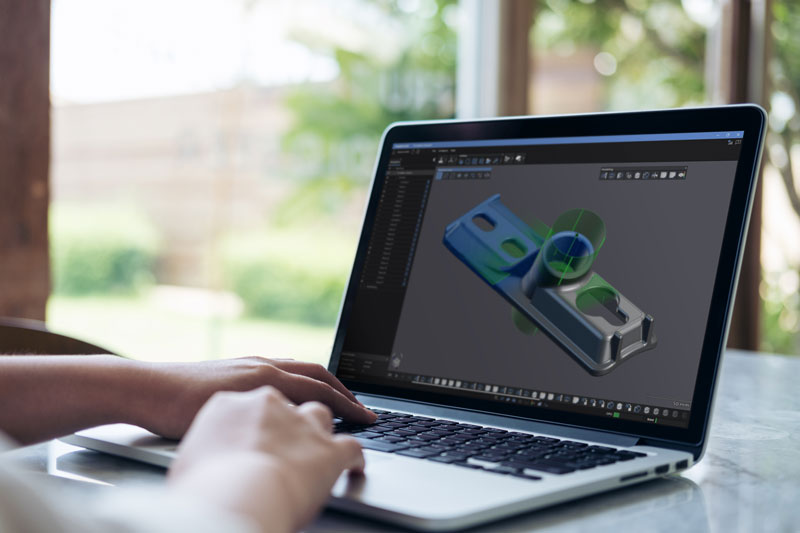
Departure: Raw Scan Data
Destination: Parametric CAD Models
Converting raw scan data (point clouds or triangular meshes) into parametric CAD models (with editable parameters) can be labor-intensive. Many software tools struggle with automated feature recognition, requiring manual input to recreate surfaces, dimensions, and features. This not only adds significant time to the design process but also increases the potential for trial-and-error iterations.
Moreover, a triangulated surface imported directly into CAD software results in a dead surface—useful for visual reference but ineffective for extracting information, as CAD software lacks the necessary tools for mesh editing, alignment, and feature recognition.

Hurdles on the Road
Feature Recognition and Extraction: When starting with noisy or incomplete data, identifying and extracting features, such as planes, cylinders, or holes, complicate the tasks of product designers who must manually recreate these features in CAD, which is both time-consuming and prone to inaccuracies.
Alignment and Registration: Aligning scan data to a known coordinate system or across multiple scans can be tricky, especially when the object lacks clear reference points. Product designers must be cautious, as initial misalignment can lead to incorrect dimensions and inaccurate feature orientation in the final CAD model, delaying reverse engineering and increasing the risks of errors.
Data Cleanup: Raw scan data often contains noise or gaps that must be cleaned or interpolated. Otherwise, poorly processed data can result in inaccuracies in the CAD model or unnecessary complexity in the design.
Surface Reconstruction: Creating smooth, accurate NURBS or parametric surfaces from mesh data is often challenging, especially for freeform or organic shapes. Without the right tools, product designers risk gaps, overlaps, or oversimplified geometry that can compromise the usability of their CAD models.
Workflow Integration: Many software platforms require product designers to switch between multiple tools to transition from scan to CAD, disrupting their workflow. These back-and-forth steps often increase the risk of errors and add to the learning curve.
Learning Curve and Expertise: Advanced scan-to-CAD tools often come with a steep learning curve, requiring expertise to achieve optimal results. Complex software slows adoption and makes reverse engineering less accessible to general users.
Addressing these challenges requires robust, user-friendly software that bridges the gap between raw scan data and CAD, enabling the acquisition of detailed and rich information from a fully digitized surface. Only then will reverse engineering be faster, more accurate, and more accessible.
Free Pass to Destination
- Software with feature recognition and automated feature extraction that reduce user intervention
- Software tools that offer intuitive and precise alignment workflows
- Automated mesh repair tools that strike a balance between removing noise and preserving important details
- Advanced and intuitive surface reconstruction tools that provide user control over the degree of simplification or smoothing
- Integrated solutions that provide seamless interoperability between scan processing and CAD software
- Intuitive user interfaces and guided workflows that lower the barrier to entry

Fast One-Way Path to Parametric CAD Models
With Creaform.OSTM and the Creaform Metrology SuiteTM, data acquisition and extraction of all the required information for reverse engineering occur within a single software platform. Once features are extracted, all information is transferred parametrically to CAD software as editable parameters, eliminating the need for product designers to continually return to the acquisition platform in search of missing information.
Then, in their preferred CAD software, product designers can easily explore new design variations based on the original geometry. Parametric modeling also enables them to make global changes, such as adjusting wall thickness or hole diameters, without the need to remodel the entire part. Additionally, it helps them maintain a clear design history, making future edits more manageable and predictable.
Integrating data acquisition and feature extraction into a single, intuitive platform also enables product designers to learn just one interface, streamlining software adoption and making reverse engineering more accessible to all.

Optimized Time in the Acquisition Platform
Not only is it easier to extract the required features, but richer information is transferred parametrically to CAD software, eliminating the need for countless back-and-forths between the scan and CAD platforms.
Efficiency in the CAD Software
With richer information obtained through an intuitive interface, product designers become more efficient and can develop higher-quality products in fewer iterations.
As a result, time to market is faster.
Published 02/20/2025