

- Article
- Related
In European automotive manufacturing, aluminum die casting is under pressure. EV platforms require lighter components. OEMs are tightening dimensional tolerances. And Tier-1 suppliers like Nemak face higher expectations around cycle time, traceability, and accuracy, especially when dealing with complex molds that must run flawlessly to keep throughput in check.
Nemak supplies lightweight aluminum solutions to major automotive manufacturers around the world. Its work spans e-mobility, structural and chassis components, and traditional powertrain applications. In 2023, Nemak’s 24,000 employees across 38 plants generated 5.0 billion USD in revenue.
For Nemak’s plant in Spain, mold maintenance had quietly become a bottleneck. Each repair required delicate craftsmanship, judgment calls, and manual checks. Some days, it worked perfectly. Other days, the smallest geometric deviation could cascade into downstream defects, rework, or even mold downtime—costs no automotive supplier can afford.
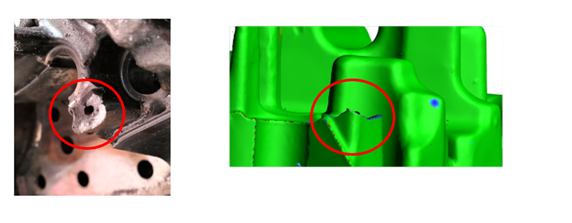 The initial 3D scan taken after a part of a mold broke.
“We needed a way to make repairs faster and more accurately,” said Iñigo Etxabe, Metrology Team Leader.
“The artisanal approach was becoming too demanding for the volume and complexity of our work.”
That became the turning point.
In Die Casting, Small Deviations Create Big Consequences
Nemak’s molds face repeated cycles of heat, pressure, and wear. Over time, even a slight deformation can compromise part geometry. Before adopting handheld 3D measurement, Nemak relied on manual checks and experience. These methods worked, but they demanded time, patience, and a level of craftsmanship that left little margin for error.
The team encountered several issues. Repairs took longer than they should. Geometry validation was harder to verify with confidence. Detecting subtle deviations during maintenance required a trained eye rather than data. Miss one detail and a mold could return to production with hidden flaws.
“We wanted to avoid failing a repair because geometry was not fully understood,” Iñigo explained. “We needed a faster and more reliable means to acquire 3D measurements.”
The team also had practical criteria. Any new solution had to be portable, lightweight, easy to use, and ready to operate directly in the workshop.
Creaform’s 3D Scanning Technologies Reveal Hidden Problems
After evaluating different technologies, Nemak selected the HandySCAN BLACK™|Series combined with Inspection, the software module for part inspections that is part of the Creaform Metrology SuiteTM, due to the solutions’ speed, flexibility, and accuracy.
“Other options felt rigid,” said Iñigo. “The HandySCAN 3D gave us freedom. Its handling and portability were major game-changers.”
Why Creaform fit Nemak’s needs:
- Lightweight, truly portable scanner that can be used directly next to the mold
- High-accuracy scanning, regardless of shop floor conditions
- Integrated 3D scanning software dedicated to part inspections
- Short onboarding time: technicians were comfortable 3D scanning within weeks
- Straightforward integration and intuitive interfaces that required no disruptive process changes
Nemak acquired the 3D scanner in 2022. Implementation was easier than the team anticipated. “Everything went smoother than even our expectations,” Iñigo noted. “Onboarding was much faster than we thought.”
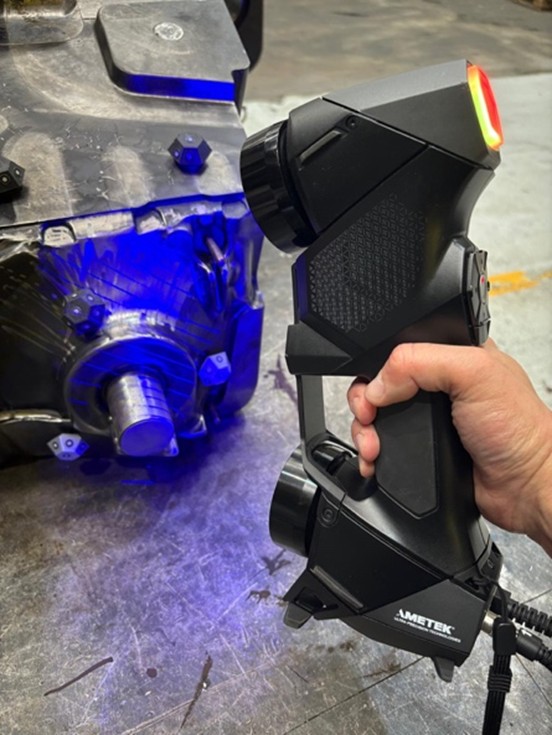 HandySCAN BLACK™|Elite helps Nemak’s technicians to acquire accurate 3D measurements for a wide range of complex parts.
One of the first major uses of the HandySCAN BLACK™|Elite involved a mold that required corrective machining after repeated thermal stress. Nemak needed a detailed understanding of the wear patterns to plan an effective repair.
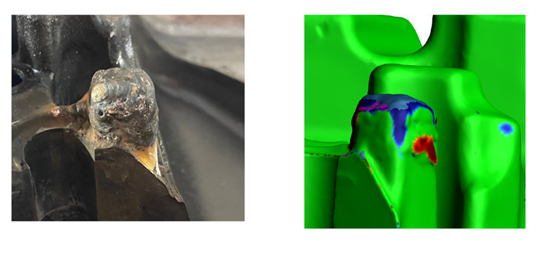 The second 3D scan captured while the repair was in process.
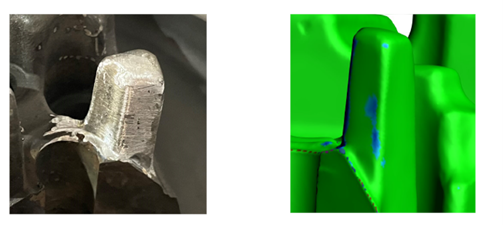 The third 3D scan recorded after completing the repair.
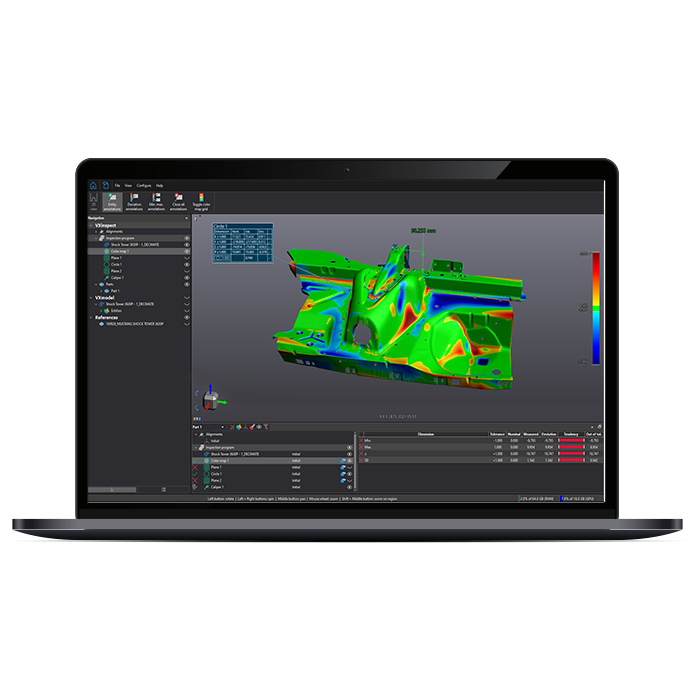
With the new workflow, the team began by scanning the damaged sections of the mold directly in the workshop, capturing the complete geometry of the worn areas. Once the scan was loaded into Inspection, the software exposed every deviation from the original CAD model, making it clear where the mold had shifted and by how much.
That information became the roadmap for the repair. Technicians could approach machining and welding with a clear plan, understanding which surfaces needed attention and which to leave alone.
What used to rely heavily on intuition became a data-driven process. “The accuracy of the scan makes the repair much more predictable. We’re not guessing anymore. We know exactly the work to be carried out.”
Improved Repair Quality and More Predictable Mold Production
Once the team began using the HandySCAN BLACK™|Elite and Inspection in their regular maintenance cycles, the change was gradual but noticeable. Repairs stopped feeling like long troubleshooting exercises. With the scan data in front of them, technicians could see the real condition of a mold before deciding how to approach it. That alone made the work move faster, because there was no need to double-check assumptions or repeat steps to make sure nothing had been overlooked.
The repair process also became more structured. Instead of relying solely on experience, technicians could follow a clear sequence based on measured deviations. Tasks that used to slow them down, such as confirming whether a surface was truly within tolerance, now took only a few minutes. Over time, these small gains added up. Molds returned to production sooner, and the team spent less energy managing the unexpected.
Employees felt more at ease with the repairs they were delivering because the geometry matched what the CAD model required. There was less back-and-forth with production and fewer interruptions caused by unclear measurements.
“The work is faster and more reliable. You can see it in the day-to-day,” said Iñigo.
Nemak plans to continue optimizing its new 3D scanning workflows. Inspection during approvals, deeper integration in mold lifecycle management, and more advanced corrective workflows are all being planned.
“We have a solid foundation now. The goal is to keep refining our process as production demands evolve.”
Interested in learning about more other case studies for top-quality die castings? Get the details on how EXCO Engineering makes it happen.
Published 01/30/2026