- Article
- Related
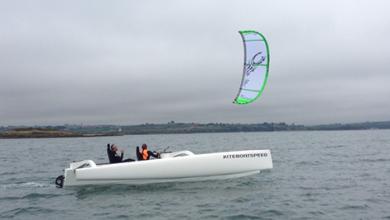
Thanks to MetraSCAN 3D and to reverse engineering , Creaform and the students of Cachan's École Normale Supérieure (France) are working on the metamorphosis of a new type of trimaran: the Kiteboatspeed (KBS). Redesigning the hull, they will assign the trimaran a new mission and adapt the latter for skippers with disabilities. To do so, Creaform is in charge of the 3D scanning while the students are taking care of the reverse engineering.
Kiteboatspeed project: A human and technological challenge
Cachan’s Ecole Normale Supérieure: A rich history
Reverse engineering in the service of the project
In 2014, ENS Cachan asks Creaform to partner with them in order to do so. « We must scan the existing to test the modifications virtually, come up with a 3D print and assemble all the parts, to get a miniature model that will support the team in their presentations and communications. » One of the goals is to get a CAD model to define modular control solutions that will help adapt the boat to different types of disabilities. In order for ENS students to work from a 3D model, and to do the reverse engineering, 3D scanning of several parts is required.
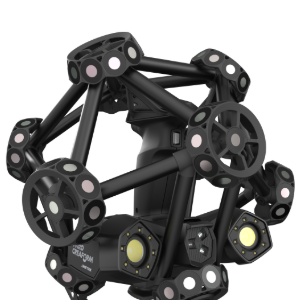
As ENS Cachan’s Laboratoire Universitaire de Recherche en Production Automatisée (LURPA) only has a Creaform C-Track dual-camera sensor, two technical experts came on-site to proceed to the scanning, with the help of both MetraSCAN 3D optical CMM scanner and MaxSHOT 3D photogrammetry system. Combining the accuracy of Creaform’s MetraSCAN 3D and the performance level of MaxSHOT 3D, the scanning of the trimaran is completed with an optimal accuracy, even in conditions that would be inadequate if the team was using other conventional measuring systems.
Reverse engineering: Scanning to give a second life
In order to create the models that the team doesn’t have at his disposal, the trimaran is disassembled first. Creaform’s experts can therefore scan both floats, both arms and the central hull of the boat, individually.
The scanning of the trimaran’s hull is performed as followed:
1. Hull’s instrumentation: positioning of gauges, targets and reference targets.
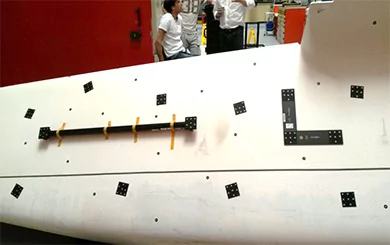
2. Photogrammetry with the help of Creaform’s MaxSHOT 3D.
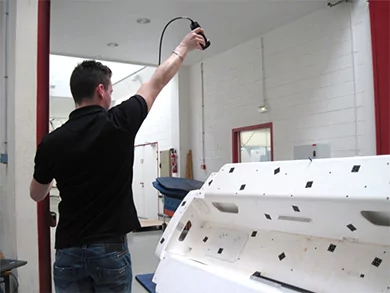
3. Scanning of the half-hull with the help of Creaform’s MetraSCAN 3D.
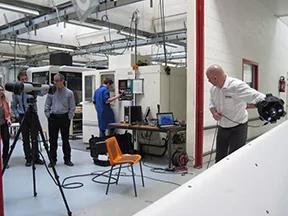
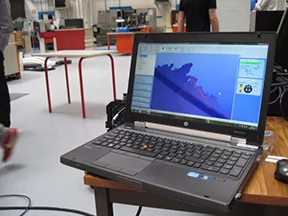
4. Data acquisition performed by Creaform’s experts.
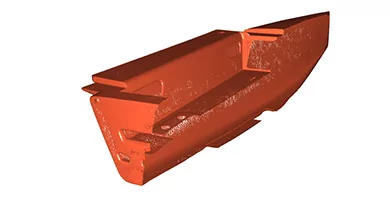
5. Mesh treatment.
6. Reconstruction of symmetry and full hull.
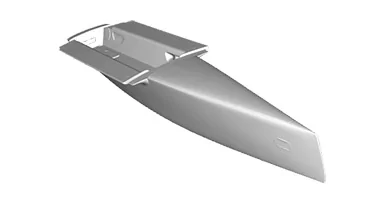
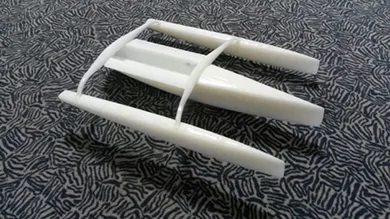
7. Central hull and other parts of the boat are 3D printed using ABS plastic strings to get a prototype.
8. Surface treatment and assembling of the parts.
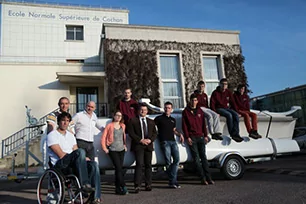
The team is satisfied!
With the help of Creaform’s metrology solutions, it is possible to scan volumes similar to the trimaran, which dimensions are 6m x 5m x1m. Of course, it would have been possible to re-create the 3D geometry using a modeling software. However, this operation is time-consuming and would be very difficult to complete, considering the complex geometry of the hull and arms of the boat. The experience shows that the unique advantages of Creaform’s metrological solutions is to be able to re-create 3D objects which models are missing or non-existing, regardless of the instability of the environment conditions.
Creaform and the field of education
Creaform's 3D optical measurement and 3D technologies became current and recurring topics in the world of metrology. In fact, since 2005, an increasing number of institutions around the world use them and teach the basics. Ever attentive to keep up with the most recent technologies, they make sure the research staff, the teachers and the students can understand and master that type of equipment.
After one year of collaboration with ENS Cachan, a solution for the remote-piloting of the kite's wing has been validated, a solution that the team will apply to the actual prototype used for real tests in the fall of 2014.
The goals of fall 2014 will be to determine the trimaran's breaking points distribution and to simulate the efforts considering the new 3D modifications.