

- Article
- Related
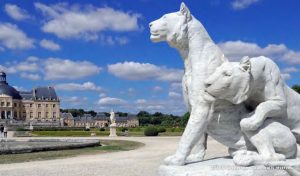
Today, while the statues of the estate are breathtaking, they are nonetheless 110 to 360 years old. Sadly, due to constant exposure to varying weather conditions and a green environment, the condition of these statues is now affected by lichen, moss, erosion, and breakage that in turn threaten the integrity of the 61 statues of the estate. The deterioration of their structure has prompted the Chief Architect of Historical Monuments (CAHM), the Regional Directorate of Cultural Affairs (RDCA) and the De Vogüé, family, owner and manager of this private estate, to launch a campaign in order to restore this heritage and which shall be sponsored by individuals and businesses.
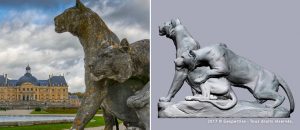
Funding Campaign for the Preservation of the Estate
4 restoration priorities
Today, both individuals and companies are swinging into action alongside the co-owners of the estate, to safeguard the preservation of such a masterpiece. The restoration program is estimated at 13 million euros over the next ten years and is based on four fundamental priorities:
- Preserve the garden (planting trees to restore a major natural space)
- Restore the palace (restore the transparency of the 3 arcades north and south of the palace to allow visitors to perceive, from the entry gates, the skyline of the garden despite the thickness of the building)
- Restore or acquire works of art (restore the 24 statues presented in the garden)
- Increase access and promote culture (promote access to the site for people with reduced mobility)
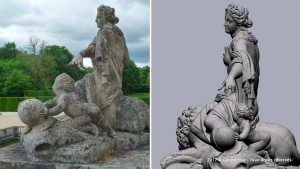
Keeping the memory alive in 3D
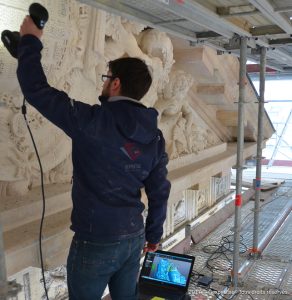
Although restoration is, first of all, performed by cleaning the works of art, it was strongly suggested to find a method that would preserve the 61 statues of the estate, without damaging them and keep their memory alive. Thanks to 3D scanning, Gexpertise’s modeling division, a specialist in the technical study of buildings and expert in 3D models worked on the estate’s digital preservation by creating a heritage archive using a hand-held 3D scanner. “In addition to cleaning the 61 statues included in the restoration project, considering this significant undertaking performed in statuary garden, the CAHM also recommended the archiving of assets in its call for tenders,” says Benoit Desriaux, project manager at Gexpertise. Indeed, the slow or accidental disappearance of fragile parts of these works makes it even more important to safeguard a memory of their original shape, as complete as possible so as to be able to reproduce a copy in the future. A contemporary and inexpensive technique is 3D digitization. It replaces plaster molding, thus avoiding physical storage and allows the production of derivative products to communicate the image.
3D digital preservation allows for:
- Create a 3D database
- Measure and analyze works
- Quantify restoration works
- Develop a heritage archive
- Make 3D reproductions
- Create a virtual museum with reconstructions in case of damage
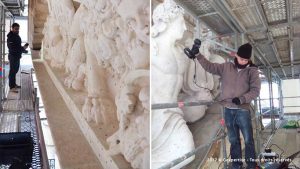
Non-contact technology, a simple 3d scanning process
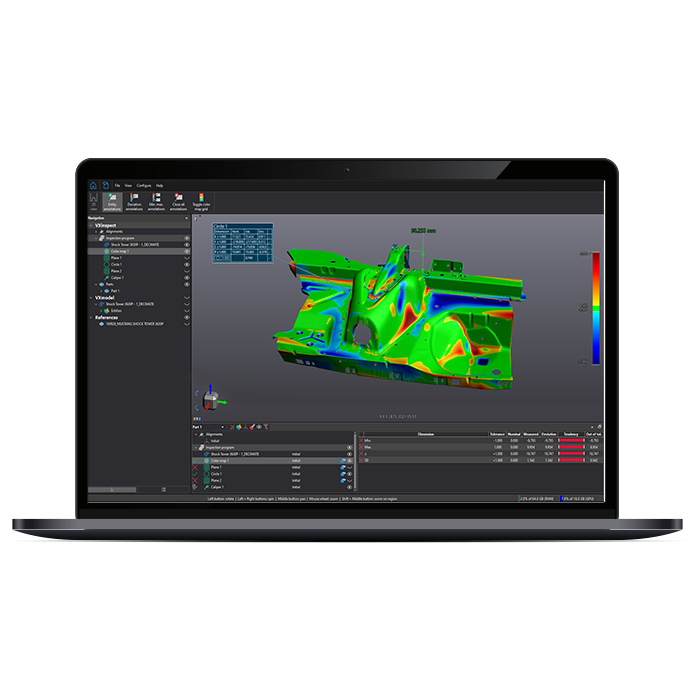
The post-processing of the generated file is carried out by dedicated software in order to stop and modify the raw modeling thus obtained. “For 3D printing, the mesh of the statue must be “clean” and “watertight”, he explains. Back at the office, cleaning the mesh, filling holes, reducing noise (smoothing) and texturing were used before the finalized file export. “One day of data acquisition in the field requires, on average, one day of processing knowing that the size of the object or its level of detail can change this rule,” says Benoit, whose role also included 3D printing consultant to the sponsors. “We are not just digitally archiving, we are seeing through the whole process and helping our clients consider all uses of a 3D printer file at different scales, such as the reverse engineering of any part of the statue,” he clarifies.
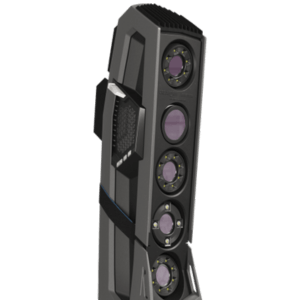
The Go!SCAN 3D scanner in the hands of Gexpertise
Published 02/13/2018