

- Article
- Related
Divija Technologies was founded in 2003 with a simple idea: bring world-class measurement and engineering capabilities to industries across India. Founded by Mr. K. Janakiraman in Chennai, the company steadily built a reputation for reverse engineering, 3D laser scanning, CMM inspection, and surface-quality analysis.
Over the years, Divija Technologies grew into a trusted partner for automotive manufacturers, aerospace suppliers, medical companies, architects, and heavy-engineering teams who needed accurate, reliable, non-contact metrology and on-site inspections.
The business’s work has taken the team inside welding assembly lines, onto factory floors, and even across entire metro cars. When Alstom Sricity needed a fully digital metro car model, Divija Technologies scanned the entire train using FARO CREAFORM 3D measurement technologies. When Whirlpool shifted a complete front-loading washing-machine line from China to Pondicherry, Divija Technologies digitized every part so the company could rebuild its documentation from the ground up. These projects, among many others, shaped a team that thrives on technical challenges and tight deadlines.
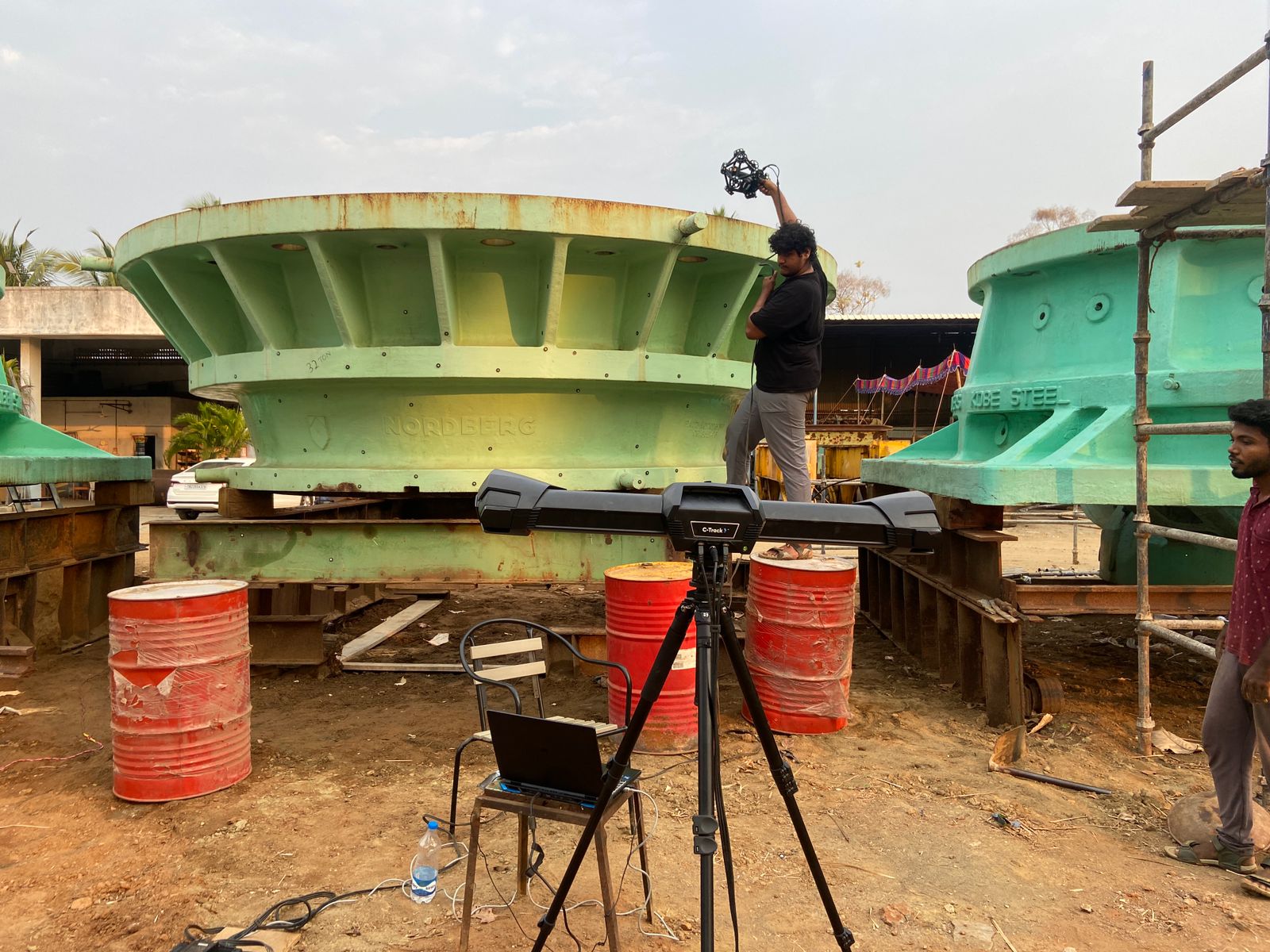 A Divija Technologies team member uses MetraSCAN BLACK+™|Elite to capture 3D measurements of large parts located outdoors.
Heat, Dust, and Complex Geometries: The Project That Pushed Limits
When Thriveni, a diversified mining company with operations in India, Indonesia, and Africa, reached out for a new project, the mission looked straightforward at first glance: acquire the 3D measurements of a series of massive mining components at its Salem facility to evaluate wear, prepare for refurbishment, and ensure accurate reassembly.
The parts measured up to six meters in diameter, some curved, some recessed, and all difficult to handle. The work had to be done outdoors. There was no controlled environment, no stable flooring, and no protection from sun, heat, dust, or unpredictable weather.
“We immediately knew sunlight was going to be our biggest enemy,” explained Janakiraman Kanthinathan, who oversaw the project. “Tracking loss in direct sun is no joke, especially around noon. If the system can’t see properly, you’re done.”
The geometry of the parts added even more difficulty. Many surfaces were hidden behind deep recesses or curves. Others were positioned at angles that made access awkward. And because the client insisted on full coverage inside and out, even the smallest pockets had to be captured.
Target placement became a major problem. With the company’s previous 3D measuring tech, 3D scanning large parts meant applying thousands of reflective targets. On rusted, dusty metals exposed to heat and rain, targets fall off. When users lose targets, they lose time and sometimes entire data sets.
“We could see it immediately,” said Janakiraman. “If we had used our legacy 3D scanners, we would have spent half a day just placing targets. And there was no guarantee they would stay on, especially in the heat.”
To make the project possible, the team adjusted the workday around the sun. They began at four in the morning, scanning until the heat and glare became too intense. In the evening, once the light softened, they picked up where they left off and worked until late at night. The schedule wasn’t ideal, but it was the only way to maintain stable 3D scanning in outdoor conditions.
The team also reorganized their entire approach to maneuverability. Instead of treating each component as a single object, they broke the surfaces into sections and mapped out a path that would allow them to work around dips, curves, and narrow spaces without losing sight of the measurement field.
Groundbreaking 3D Scanning Accuracy Regardless of Harsh Conditions
The decision to use MetraSCAN BLACK+™|Elite, the industry’s fastest optical CMM scanner, along with Inspection, the software module for part inspections in the Creaform Metrology SuiteTM, changed the entire trajectory of the project. For Divija Technologies, this scanner brought something their previous equipment never could: unprecedented freedom. Freedom from targets. Freedom from sprays. Freedom from rigid setups that simply didn’t work in rugged outdoor conditions.
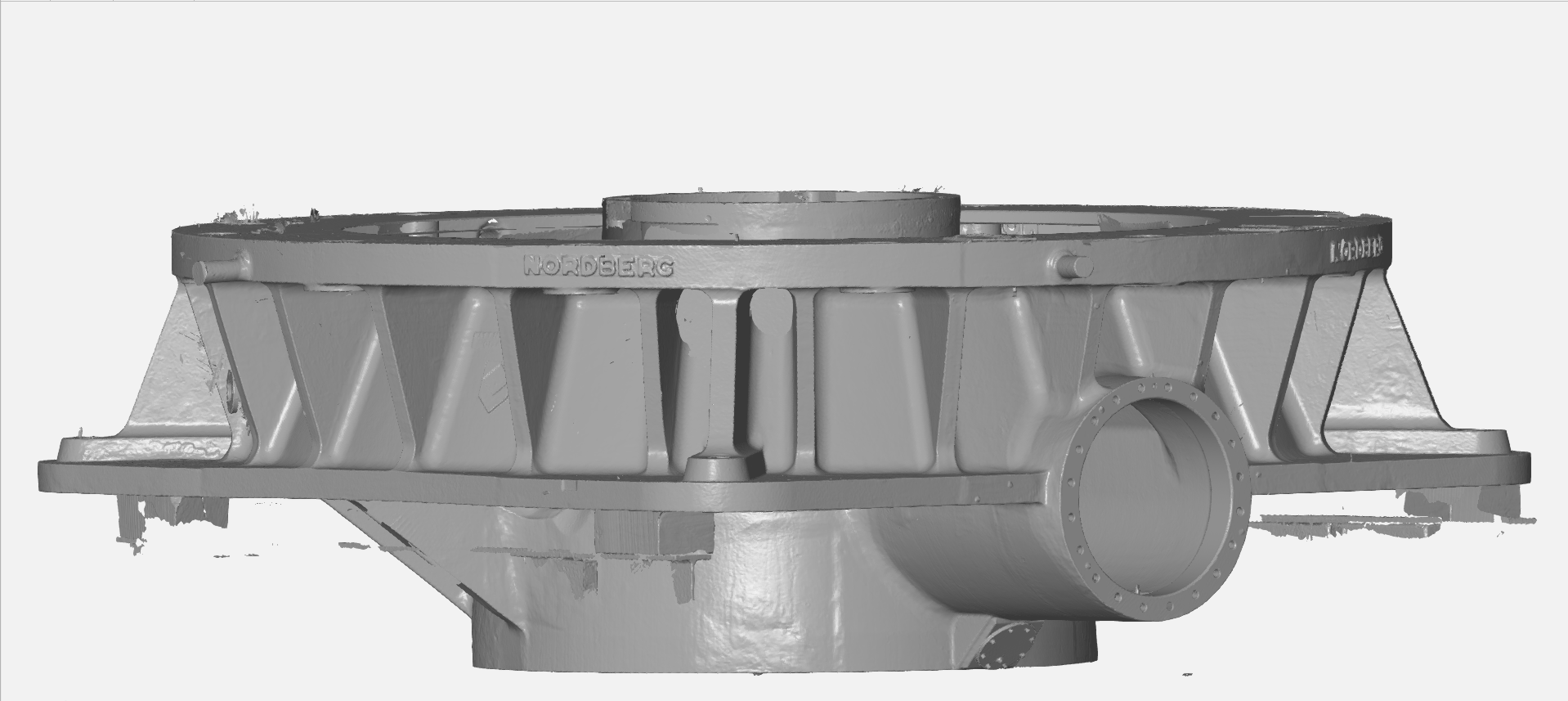 The MetraSCAN BLACK+™|Elite provides highly accurate 3D scans of parts of all sizes, surfaces and geometries.
The MetraSCAN BLACK+™| Elite's ability to capture thin surfaces, complex curves, and discontinuous segments without targets made the inspection manageable throughout. The system’s large measurement volume allowed the team to move these enormous components around with far fewer adjustments. It also meant they could reach both sides of sheet-metal-like areas (sometimes only three millimetres thick) without any extra prep work.
“Once the part was inside the measurement volume, we knew we could scan it,” explained Janakiraman.
“That level of assurance is rare on a job like this.”
Janakiraman Kanthinathan
Even the mud and unstable planks caused by heavy rain couldn’t derail the process. The scanner remained consistent, and Inspection handled 20–30 GB data sets without crashing; this was a level of stability the team had not always experienced with previous systems.
When the Right 3D Scanner Turns a 12-day Job into 5
By the time the last component was scanned, the result was undeniable: the project would not have been feasible with Divija Technologies’ earlier equipment. What could have taken twelve working days took five. Instead of using an estimated 4,000 adhesive targets, the team used 40 magnetic targets. The team even reused half of them during tracker repositioning.
Because the project finished ahead of schedule, Divija Technologies avoided penalty fees and reduced its food and lodging costs from an estimated 48,000 INR to 20,000 INR. More importantly, the team delivered precise volume data that allowed Triveni to plan refurbishment timelines.
This project also transformed the company’s internal practices. Anything larger than two meters used to trigger concerns about setup time, tracking reliability, and the risk of losing targets midway through a scan. Now, the team no longer worries about target placement or accessibility. Technicians position the component within the scanner’s range and begin working.
“The simplicity has changed our whole mindset,” Janakiraman said.
“Before, we would talk about how to scan these parts. Now, we talk about how quickly we can get them done.”
Janakiraman Kanthinathan
Although Divija Technologies didn’t need technical support during this project, the company credits FARO CREAFORM’s team for building their confidence early in the technology adoption process. Training was hands-on and thorough, and questions were answered before the scanner ever left the demo room. That reliability, combined with consistent scan quality, has strengthened their trust in FARO CREAFORM’s technology.
Divija Technologies has already invested in other 3D measurement solutions, acquiring the HandySCAN MAX™|Elite for scanning parts over 10 meters in size.
Proof That Large-scale Scanning Doesn’t Have to Be Difficult
The Salem project tested everything: sun, rain, dust, unstable ground, irregular shapes, tight deadlines, and large-scale industrial components that refused to cooperate. What made it successful was the combination of Divija Technologies’ field expertise and FARO CREAFORM’s high-quality, metrology-grade solutions.
It shortened timelines, simplified workflows, and removed layers of complexity that used to slow their projects down. For Divija Technologies, it marked a shift toward a more agile and reliable approach to metrology.
“As long as the part is inside the measurement volume, we know we can scan it,” says Janakiraman. “For us, that’s the difference between worrying about a job and delivering it.”
Divija Technologies has hands-on experience in reverse engineering using 3D scanners, especially drone blades. They also support major defence industries clients for missile, tank, engine, scanning, rocket, and major engine MRO fixturing.
Interested in learning more about metrology solutions in the mining industry? Discover how a mining engineering firm opened a new MRO segment thanks to 3D scanners.
Published 03/04/2026