

- Article
- Related
Automotive sheet metal parts must meet tight dimensional tolerances to ensure proper assembly. Even minor deviations can result in fitment issues, such as misalignments, gaps, or interference between components. Defects not detected in early production stages can disrupt the manufacturing process, delaying production schedules and increasing scrap rates.
Quality control (QC) plays a critical role in detecting those deviations and ensuring parts meet stringent tolerances. However, few inspection solutions are versatile enough to accurately measure sheet metal parts regardless of environmental conditions and user expertise.
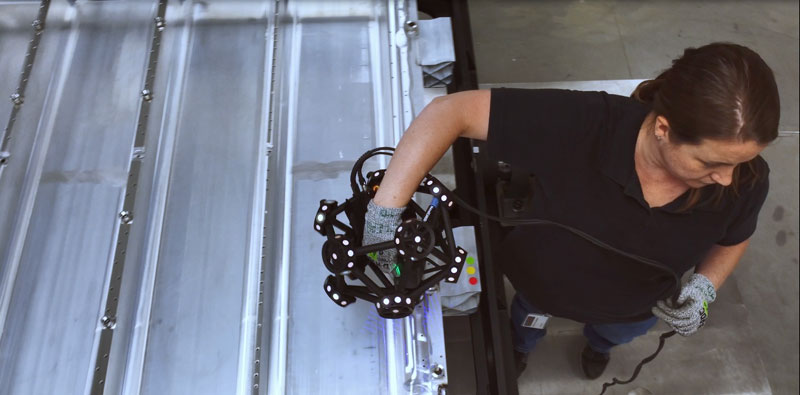
Why is the CMM not the most efficient inspection method for ensuring sheet metal quality?
Sheet metal parts often feature intricate, irregular shapes with complex curvatures and thin profiles. The necessity of calibrating each probe orientation to measure the entire geometry adds to the inspection process, increasing time and reducing efficiency. In addition, areas like edges, tight corners, or undercuts may be inaccessible or challenging to measure, leading to incomplete inspection.
Although CMMs are highly accurate, they operate slowly and require skilled operators for setup and use. This limits accessibility and efficiency, creating bottlenecks in the manufacturing process and extending inspection times.
Why are checking fixtures not the most economical inspection solution for sheet metal?
Checking fixtures are part-specific. This lack of versatility means they cannot be reused for different designs or adjusted for frequent product changes. They also require regular maintenance due to wear and tear, increasing long-term costs, and their bulky nature demands significant storage costs. Furthermore, any modification to the sheet metal part renders the fixture obsolete, requiring a new fixture and expenses.
Why is white light technology, combined with the gray cloud extraction technique, not the most accurate method for inspecting sheet metal quality?
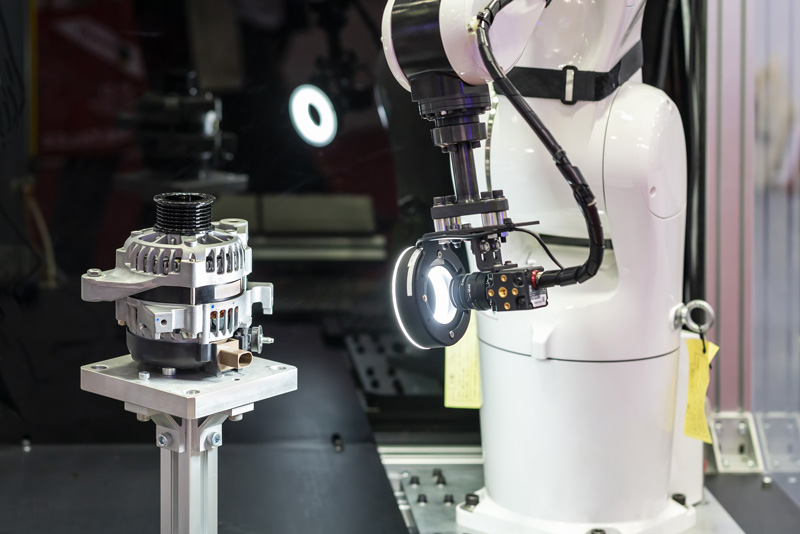
The gray cloud extraction technique performs optimally only under specific, controlled lighting conditions. Any slight variation in ambient light and background—common on shop floors—can cause the white light technology to capture varying amounts of light. This interference can affect the measurement of sheet metal parts, potentially impacting edge detection and measurement accuracy. Moreover, multiple parameters require adjustment, making accuracy dependent on the user's ability to navigate these complexities.
Why do QC professionals in the automotive industry not fully trust 3D scan data compared to CMM results?
It is often easier to question the reliability of data and equipment than to address potential manufacturing defects, especially with complex sheet metal parts that require accurate data acquisition and thorough analysis. Consequently, the quality department must eliminate ambiguity and variations originating from the equipment or the measurement method.
These measurement variabilities may result from the acquisition (sensitivity to the environment and acquisition parameters) or the extraction parameters, which differ from one sheet metal model to another. Thus, a solution insensitive to environmental variability, with proper guidance during acquisition and no extraction parameters, is required.
Efficient, Versatile, Environment and Operator-Independent Sheet Metal Inspection Solution
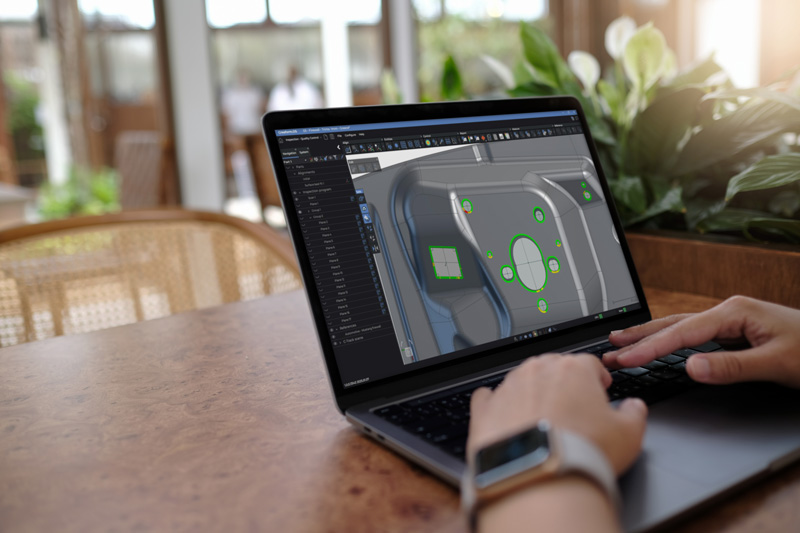
Speed: Compared to CMMs, 3D scanners provide faster sheet metal inspection results due to their ability to capture comprehensive data in a single scan. When integrated with advanced software, they process 3D scan data quickly and display the best fit with CAD in just three quicks, ensuring the fastest path to reporting.
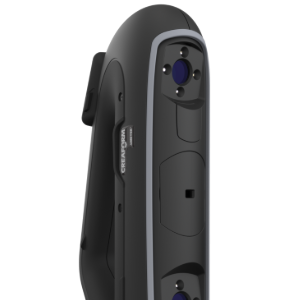
Versatility: Compared to checking fixtures, laser scanning systems are highly versatile and capable of measuring various part shapes and sizes without the need for custom fixtures. As a single 3D scanning device can adapt to different geometries, design changes and adjustments to automotive parts are easily feasible.
Simplicity: When data acquisition occurs in a simple, intuitive interface that visually indicates which areas need inspection, it ensures sufficient data is collected for reliable quality control. The guidance during data acquisition makes the process operator-independent, removing the need for highly specialized skills.
Accuracy: The key to accuracy lies in minimizing operator dependency on measurement variability. Laser-based 3D scanners are less affected by environmental factors, resulting in fewer parameters needing adjustment during acquisition. This simplifies the measurement process, making it more reliable and accurate.
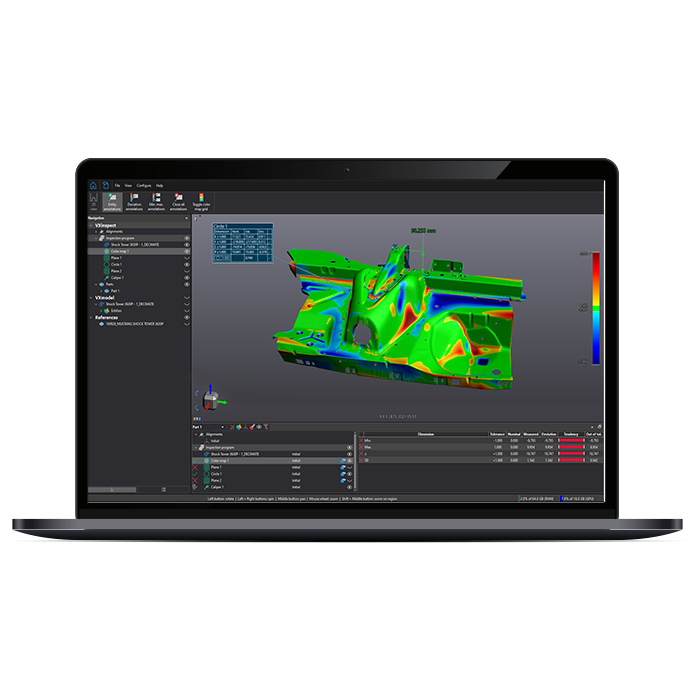
Part of the Creaform Metrology Suite™, the new Sheet Metal Add-on for the Inspection software module delivers highly repeatable and accurate 3D measurements for sheet metal, instilling confidence in 3D scan data among QC professionals.
The Sheet Metal Add-on empowers automotive manufacturers to fully trust their inspection reports
The Sheet Metal Add-on guides operators through data acquisition with a simple, intuitive interface that visually indicates which sheet metal areas need inspection. This process ensures enough data is collected for reliable and efficient quality control.
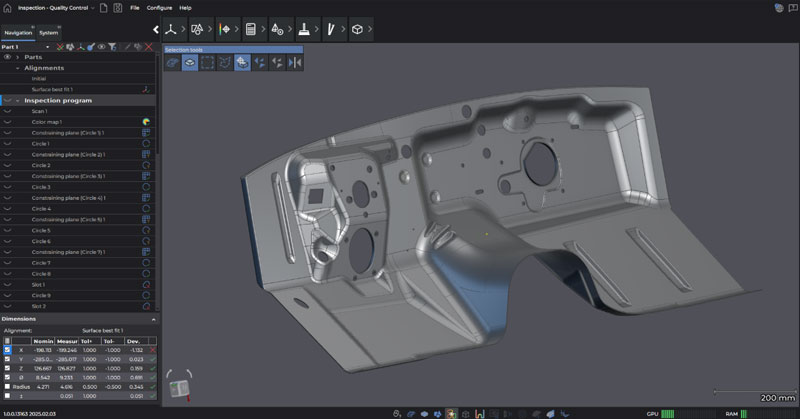
High Confidence in Inspection Results
By integrating the Inspection software module with the acquisition platform, Creaform.OS™, visual indicators and feedback remain available throughout the inspection process. This ensures that QC specialists can access acquisition parameters when evaluating whether geometric features meet tolerance requirements, eliminating any doubt about data reliability. As a result, they can confidently determine whether deviations stem from manufacturing defects or other factors such as material variations, environmental influences, or tooling issues.
Better Decision-Making to Improve Manufacturing Processes
With reliable data obtained from fast, accurate 3D scanners and the Sheet Metal Add-on, the inspection process is streamlined. QC specialists gain comprehensive insights to optimize tooling maintenance programs and enhance manufacturing processes through environmental and heat treatment checks, tooling and fixture audits, or design and tolerancing reviews.
Cost-Effective Measurement for Diverse Sheet Metal Parts
Laser scanning systems provide a highly economical way to measure various sheet metal parts without the need for custom fixtures or the associated storage and maintenance costs. A single 3D scanner is versatile and can adapt to different sizes, shapes, and geometries, making design changes and adjustments to automotive sheet metal parts seamless and cost-efficient.

NEED MORE INFORMATION ABOUT OUR SOLUTIONS?
