

- Article
- Related
Established in 1985, the National Institute for Aviation Research (NIAR) at Wichita State University is at the forefront of advancing aerospace, defense and manufacturing technologies.
As a research and development powerhouse with a $400 million annual budget, a 1,500-member team, and nearly two million square feet of laboratory and office space in six locations, NIAR provides cutting-edge research, testing, certification, and training services to the aviation, defense, and manufacturing industries. Located in Wichita, Kansas—known as the "Air Capital of the World"—NIAR supports clients in the private sector and government agencies such as the FAA and the U.S. Department of Defense.
Renowned worldwide for its expertise, NIAR specializes in technology, such as composites and advanced materials, digital twin, and cutting-edge manufacturing methods, such as automation and additive manufacturing.
The challenge: Inaccurate 3D measurements complicate R&D workflows
As NIAR expanded its defense-related digital twin programs, the team encountered issues with 3D measurement accuracy—something the Institute could not compromise on in the highly regulated aerospace and defense sectors.
Traditional methods, including manual techniques and recreating 2D drawings, were no longer adequate for capturing the complex geometries involved in NIAR programs.
For example, team members used to rely on sampling points, which limited the ability to capture complete surface data. Accuracy issues became even more apparent when working on complex work like creating digital twins for aging military vehicles.
Furthermore, the growing scope of NIAR’s projects required portable equipment capable of performing in different environments, from controlled laboratories to rugged field conditions on military bases. Delays caused by inefficient equipment also impacted project timelines.
"In our field, even the smallest inaccuracy can have serious implications. The limitations of traditional methods made it clear that we needed a new approach to 3D measurements," explained Chris Rempe, NIAR Reverse Engineering and Additive Manufacturing Lab manager. “Our main criteria for the metrology solutions we wanted were accuracy, reliability, portability and scalability.”
The solution: Three Creaform 3D scanning solutions for a multi-faceted approach
To overcome these challenges, NIAR chose Creaform’s HandySCAN 3D|BLACK Series, MetraSCAN BLACK+™|Elite optical CMM 3D scanner, and VXmodel scan-to-CAD software.
“We were impressed by the speed of data capture, the target-based referencing to accommodate various environments, compact design, and the fact Creaform’s technologies are ISO-calibrated,” Rempe noted.
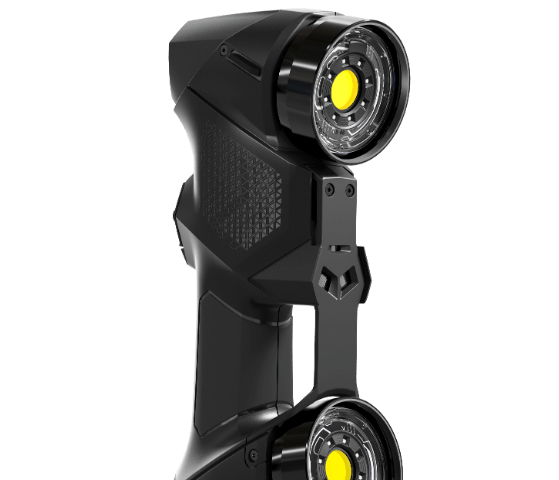
The HandySCAN 3D|BLACK Series, a lightweight handheld 3D scanner, offered impressive accuracy levels for scanning both small components and large structures in confined spaces. Its portability allowed technicians to conduct 3D scans directly in the field, eliminating the need to transport parts to a controlled environment.
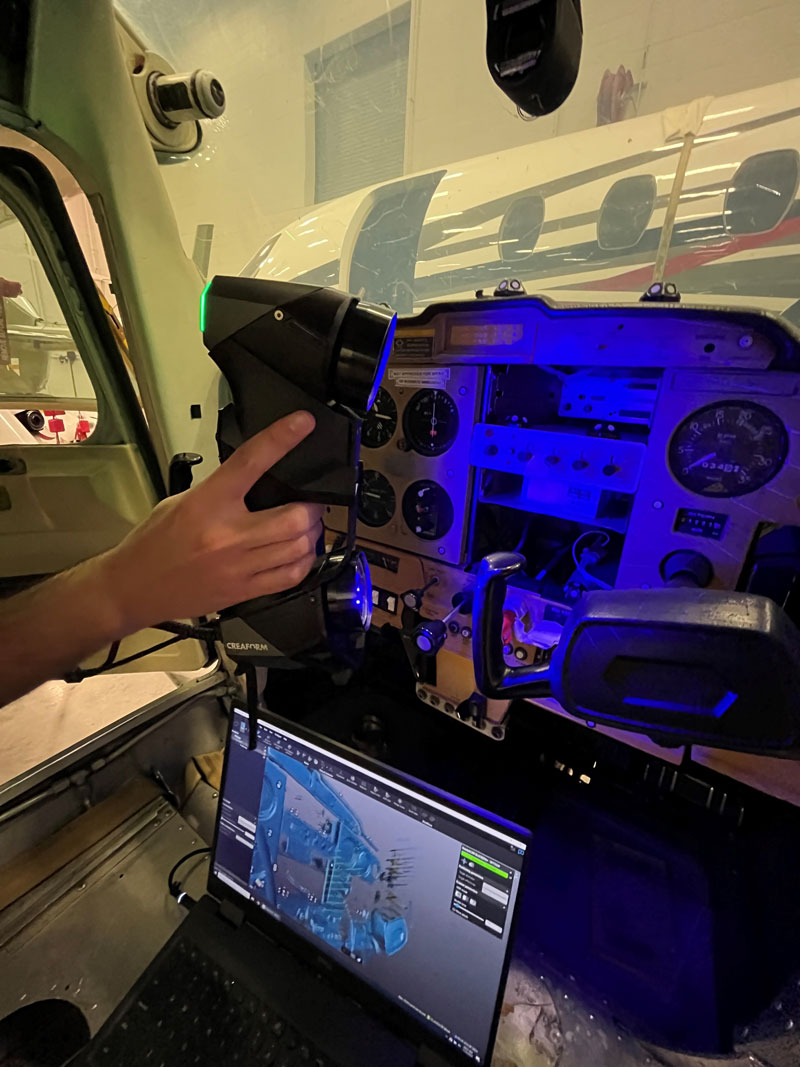 NIAR technicians use the HandySCAN 3D|BLACK Series to yield 3D scans of parts in confined spaces.
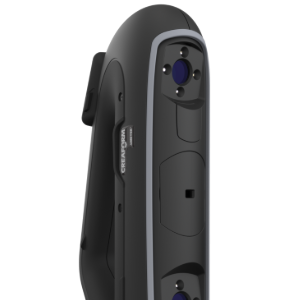
 The MetraSCAN BLACK+™|Elite, designed for high-end metrology applications, complemented the HandySCAN 3D|BLACK Series by generating fast and accurate results for huge aircraft and military vehicle assemblies.
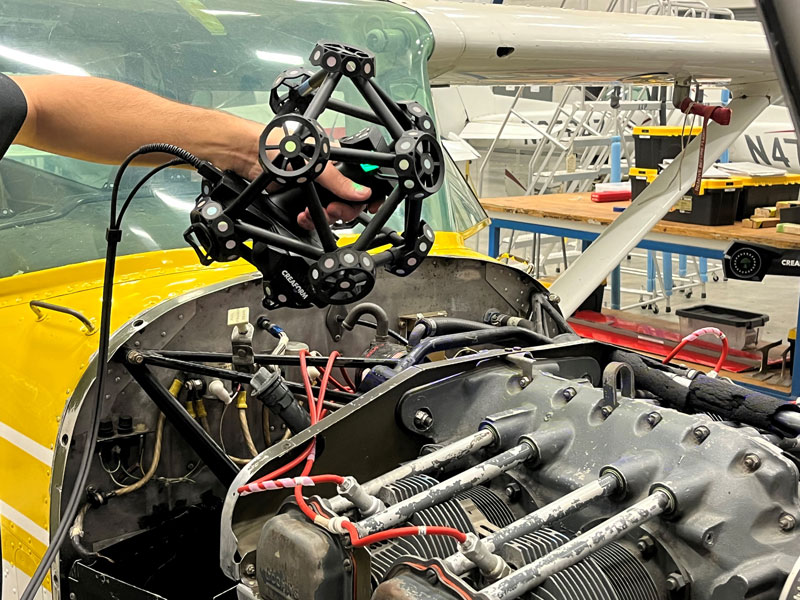 The MetraSCAN BLACK+™|Elite proves to be a game changer in capturing accurate 3D measurements of complex assemblies.
 VXmodel broke new ground in NIAR’s 3D measurement processes. It made it possible for team members to easily carry out reverse engineering tasks by converting scanned data directly into CAD models. It eliminated unnecessary file manipulations, which reduced post-scanning processing times.
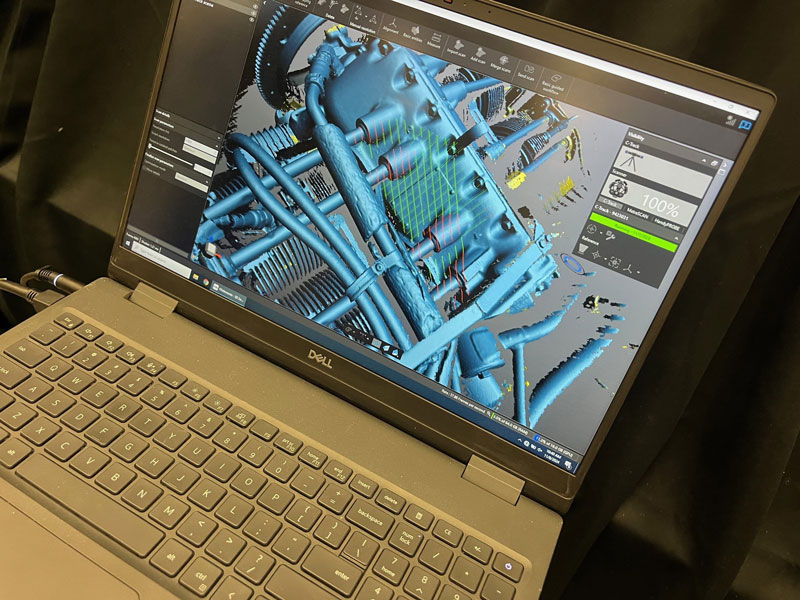 What distinguishes Creaform’s 3D scanners, apart from unparalleled speed and performance, is their integration with the company’s 3D scanning software modules.
 Thanks to the user-friendliness of the 3D scanners and software, technicians were quickly onboarded and were creating 3D scans and CAD models in no time flat in VXmodel. “Most technicians feel comfortable with the new equipment after just a few uses. That’s all it takes to get a feel for distance, angles and settings. Some bigger projects can take a bit longer, but the learning curve is relatively short regardless,” Rempe added.
The results: Increased R&D capacity and efficiency
Integrating Creaform’s solutions has significantly boosted NIAR’s research and development efforts, which meant the Institute could take on more ambitious projects. The ability to perform scans directly on-site has streamlined the team’s processes, reduced delays, and improved overall technician productivity. VXmodel software has also simplified the conversion of scanned data into CAD models, helping NIAR to achieve better results more quickly, maintaining the high-quality standards its clients have come to expect.
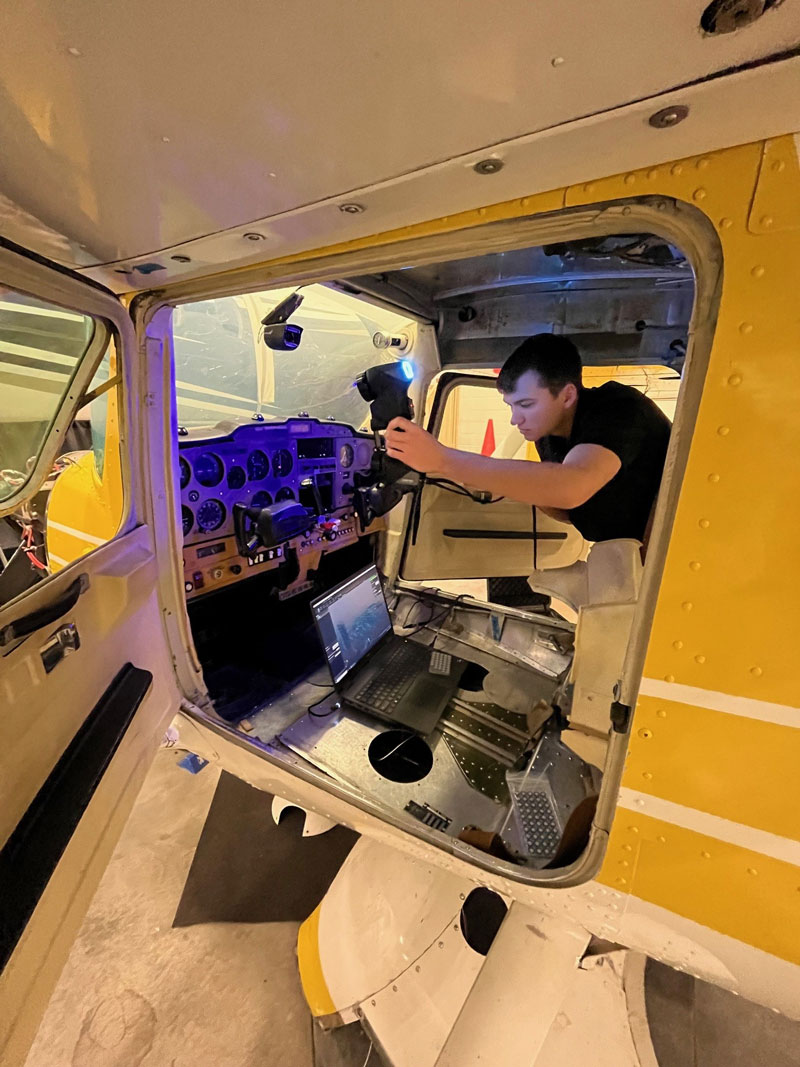 Creaform’s 3D scanners can be used to acquire highly accurate 3D measurements in any type of environment, including rugged aircraft hangars.
 Creaform’s technologies have opened the door to new opportunities, including major Department of Defense fleet sustainment projects. NIAR’s team has successfully 3D scanned entire vehicles and detailed components for aging military equipment, such as the B1 Bomber, F-16 fighter jet, Apache and Black Hawk helicopters, and the M113 armored personnel carrier. Creating highly detailed digital twins for these assets would not have been feasible without Creaform’s 3D scanning solutions. “I firmly believe our DoD digital twin programs will continue to grow exponentially,” he said.
Adopting Creaform’s solutions has brought significant financial and operational benefits. Faster project completion has increased client satisfaction and delivered measurable cost savings for both NIAR and its partners. “Creaform gave us the right technology to take on new projects where typical arms or trackers can’t be used due to off-site locations in unstable environments. Higher 3D scanner efficiency allows for less downtime, which is critical for clients and our team in most cases.”
Rempe is convinced that a new era has begun for NIAR’s R&D. “Creaform has done a great job expanding the metrology to support 3D scanning jobs of small and large components. Details of the current and upcoming projects should showcase this very well, but most must remain confidential. However, it is impressive to see the scale at which these 3D scanners are being used. We are very satisfied with our choice and the top-notch customer service Creaform provides.”
Published 06/18/2024