

- Article
- Related
In motorsports, performance often comes down to the smallest details. When engine internals are off-limits due to strict racing regulations, every gain must be found elsewhere—in the components that surround the engine. That was precisely the challenge faced by a PRO 2 Racer who suspected that the existing exhaust manifold was holding back potential power. To turn that intuition into measurable results, the racer needed a solution grounded in engineering principles rather than guesswork.
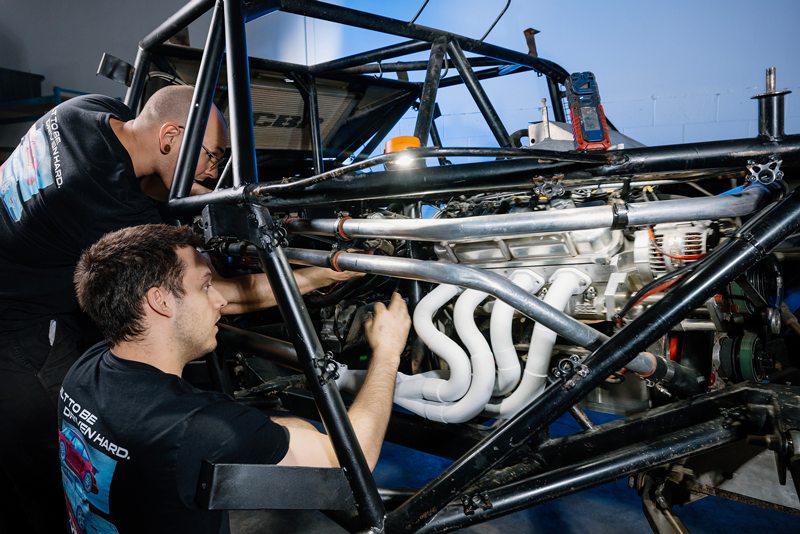
This is where EP9 Autosport—a workshop based in Quebec, Canada—came in. Renowned for its expertise in restoring, improving, and customizing air-cooled Porsche vehicles, EP9 took on the project with the same mastery and passion that define its work on classic 911s. Building on its track record of rebuilding high-performance engines and developing parts no longer available, the team applied its engineering know-how to optimize the manifold and unlock untapped power.
In this blog, we will explore how EP9 rose to the technical challenge of redesigning a Roush engine manifold—unlocking the extra fractions of a second that make all the difference on the track.
Revisiting the Manifold Geometry: A Ground-Up Redesign
A manifold was already mounted on the engine, but nothing had been analyzed nor calculated. In the initial configuration, the runners had been routed solely to fit within the chassis. As a result, key parameters such as the geometry, length, and diameter of each runner had not been optimized for balanced airflow and maximum engine output.
The engine manufacturer had provided general guidelines, including diameter and length specifications for each section and which tubes should be paired together, but the overall manifold design remained undefined. Therefore, the EP9 design team had to start from scratch, developing a new manifold that would meet these specifications while fitting within the geometric constraints of the vehicle’s chassis.
Scanning the Engine Head for a Perfect Fit
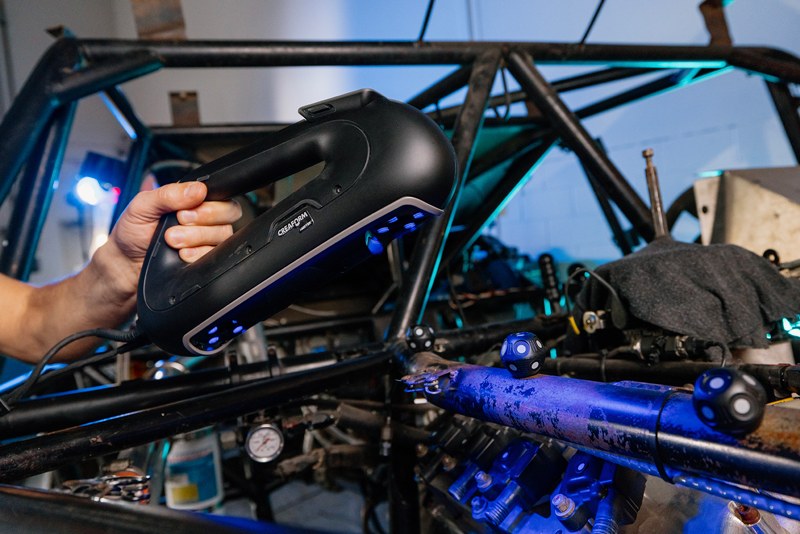
After removing the old manifold, EP9 scanned the engine head—a Ford-based architecture—to precisely capture the dimensions of the environment where the new manifold would be installed. Certain features had to be carefully considered, such as where the square exhaust ports must connect to round header tubes.
Routing the Runners for Optimal Flow
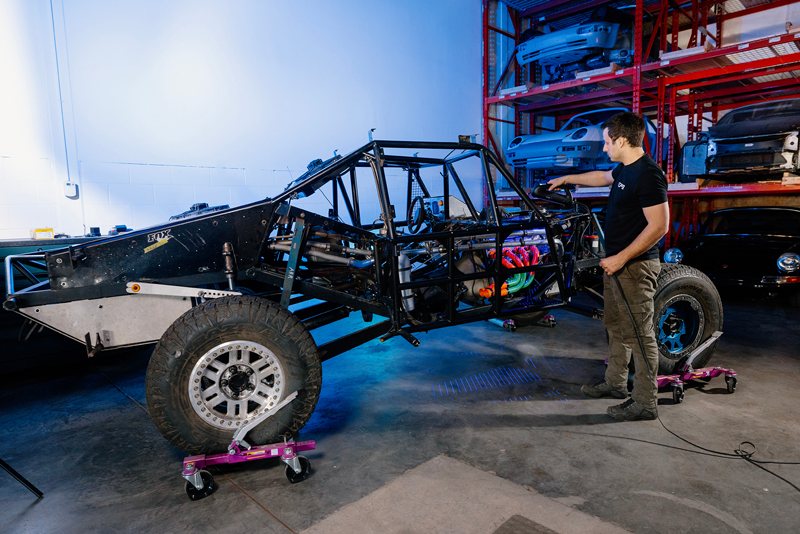
The team then used a modular plastic kit to manually route the runners, determining their overall shape and positioning to visualize the most efficient flow path. Because each segment of the kit represented exactly one linear inch, determining the total length of each runner was straightforward.
Converting the Prototype into a CAD Model
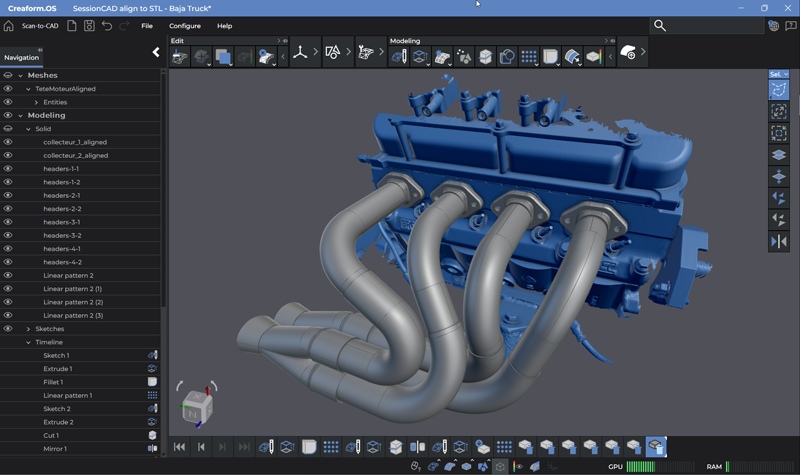
Once the prototype was finalized, EP9 turned to the HandySCAN 3D|PRO Series to digitize the physical model. Using Scan-to-CAD Pro, the design team could sketch and model the new manifold directly on the modular kit’s scan data, leading to the creation of a complete parametric CAD model.
Delivering a Perfect Fit
In the end, the CAD model was sent to machining, producing a part with optimized geometry and a perfect fit within the engine chassis—a tangible result of a perfectly executed design process, from scan to CAD to machined part.
How the PRO Series with SCAN-to-CAD Pro Transformed EP9’s Design Process
Creaform’s 3D scanning technology had long been part of EP9’s toolkit, used in Porsche restorations to reproduce unavailable parts and improve existing ones. In these projects, the design team would scan the original part to obtain accurate reference data and use it as the foundation for designing the new component.
The HandySCAN 3D|PRO Series elevated EP9’s design process to a new level of precision. With its advanced mesh enhancement algorithms, it produces exceptionally clean scan data, even on complex engine geometries. The Smart Resolution feature automatically adjusts mesh density to capture fine details where needed while speeding up less critical areas. Combined with powerful mesh data extraction from high-performance cameras and laser lines, the system delivers accurate results on challenging or contrasted finishes. Meanwhile, live mesh visualization lets engineers see the 3D model form in real time, ensuring full coverage and quality before moving to the next step.
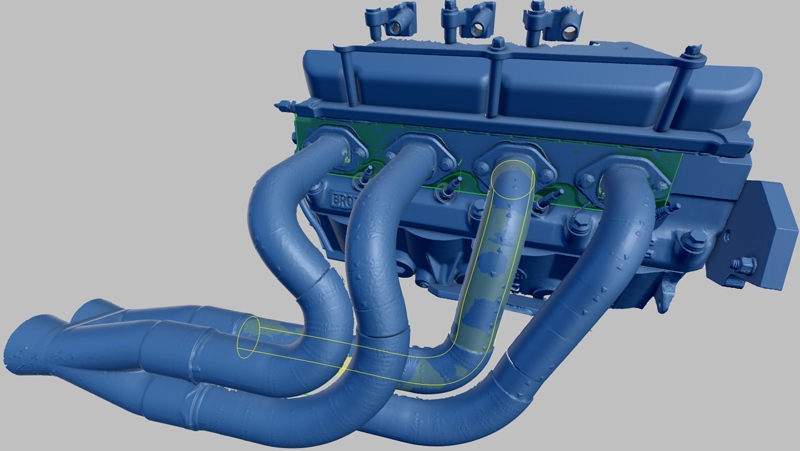
Working hand in hand with the HandySCAN 3D|PRO Series, the Scan-to-CAD Pro software module—part of the Creaform Metrology Suite—streamlined EP9’s design workflow. Once the high-quality mesh data was captured, engineers could quickly clean and optimize it using mesh editing tools before extracting features and preparing the scan for CAD. Intelligent alignment ensured the data was CAD-ready, simplifying sketching and modeling operations. EP9’s team also benefited from the ability to sketch directly on cross-sections and build 3D models within the same environment, reducing manual modeling time. Finally, parametric transfer to SOLIDWORKS allowed engineers to refine and edit feature-driven models seamlessly in their preferred CAD platform.
Streamlining the Path from Scan to Prototype
With the addition of a 3D printer, EP9 can now move from concept to physical prototype in a single day. Leveraging the combined workflow of the HandySCAN 3D|PRO Series and Scan-to-CAD Pro, the design team can go from scan data to a first, functional, testable 3D-printed part almost immediately—accelerating validation and enabling faster design iterations.
Before, getting a functional prototype could take months of back-and-forth. Now, with the HandySCAN 3D|PRO Series and Scan-to-CAD Pro, we can go from scan to CAD to a 3D-printed prototype in just one day. It has been a complete game-changer for our design process.
Félix Bélanger, engineer at EP9 Autosport
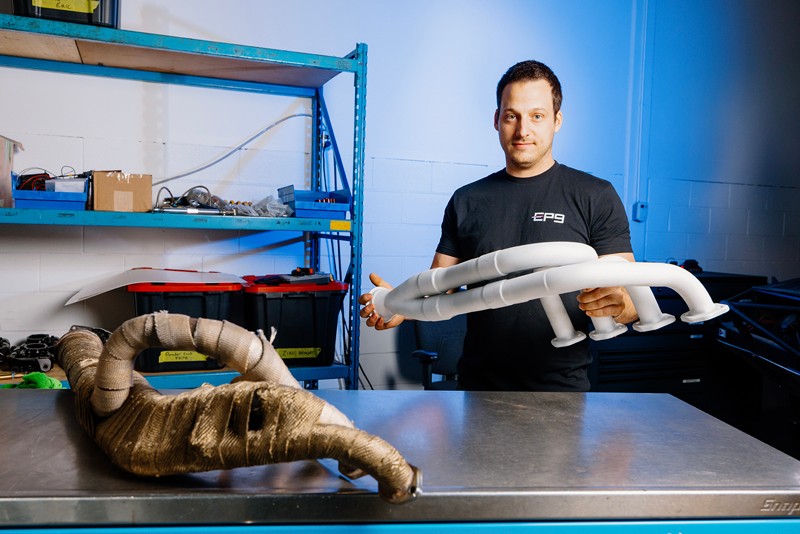
The difference compared to previous measurement methods is striking. In the past, parts were designed, sent for machining, and returned months later—only to discover they did not fit or perform as intended. Multiple back-and-forths were often required before obtaining a functional prototype.
Today, with 3D scanning and 3D printing, EP9 typically performs only two or three quick iterations to fine-tune a part before machining. Once the final version is produced, no additional adjustments are needed—it simply works, every time.
Turning Measurement Accuracy Into Design Confidence
The HandySCAN 3D|PRO Series does not just speed up the workflow—it ensures that each design iteration is built on a solid foundation of accuracy. Reliable reference data eliminates uncertainty and provides complete confidence in the surrounding geometry where the new component will be installed.
In automotive applications, where tolerances are tight and available space is limited, this level of accuracy is critical. Whether developing engine components or other performance parts, knowing the exact installation environment guarantees a perfect fit.
Empowering Teams Through Intuitive Tool
Finally, EP9 emphasizes how intuitive the HandySCAN 3D|PRO Series is. When their scanning expert was away, another team member stepped in and successfully performed a complete scan within minutes—without prior experience. Operating the device, launching the acquisition software, and completing the scan turned out to be effortless—and even enjoyable.
Results: Greater Efficiency and a Competitive Edge
With the help of Creaform’s HandySCAN 3D|PRO Series, EP9 designed a manifold that reflects the team’s engineering know-how and attention to detail. The PRO Series made it possible to refine the geometry, improve engine performance, and achieve noticeable improvements on the track—the driver immediately felt the difference.
For EP9, combining Scan-to-CAD Pro with 3D printing has completely transformed their design process. The team can now take on complex, one-off projects like this custom vehicle, redesign unique parts, and—most importantly—do so efficiently and profitably. Without the right tools, it’s easy to lose countless engineering hours during the design phase. The PRO Series significantly reduces that time, allowing EP9 to deliver high-quality, customized solutions at a competitive price.
With the PRO Series, challenges like these—common in motorsports—are no longer out of reach for small workshops with big ambitions. By scanning every project, EP9 is also building a growing digital library of chassis and engine configurations. This database allows them to revisit dimensions, analyze past work, and continually refine their designs, reinforcing their engineering expertise over time.
Compared to previous measuring tools, the HandySCAN 3D|PRO Series drastically limits trial-and-error iterations. What once took months can now be achieved in a matter of days—an undeniable game-changer for an ambitious team chasing greatness in the demanding world of motorsport.
What’s Next at EP9 Autosport
Driven by customer demand, EP9 is now preparing to launch a new Porsche engine that will combine newly engineered components with original parts. Once again, the PRO Series will play a critical role, documenting every surrounding surface to ensure each element integrates perfectly and performs at its best.
The HandySCAN 3D|PRO Series will continue to push EP9’s creativity and efficiency further—helping the team save time, reduce costs, and bring their engineering vision to reality, both on the road and on the track.
Published 11/12/2025