

- Article
- Related
Rolling stock is engineered for long service lives, often spanning several decades. But keeping locomotives, railcars, and rail infrastructure reliable over such extended operating periods is rarely straightforward. Over that time, rail operators and manufacturers must contend with aging assets, unclear documentation, and increasing pressure to maintain availability without compromising safety.
Across the rail industry, 3D scanning has steadily become a practical way to address these challenges—not as a single-purpose solution, but as a versatile measurement method applied at different stages of the rolling stock lifecycle.
.png?revision=e4e4f9d1-bb5b-4630-b770-ff68938ae677&h=379&w=794&la=en&hash=ED27DD9ED7CAE684677ADA95764596D0)
Where and How 3D Scanning Adds Value Across the Rolling Stock Lifecycle
It often begins as components arrive at the facility—before they even reach production or maintenance. By inspecting supplier parts with 3D scanning before assembly, teams can prevent costly rework and integration issues later, ensuring proper fit and reliable operation.
In production, quality control of large welded structures and inspection of forged components are also a challenge, as both are difficult to assess with traditional measurement tools. Here, 3D scanning allows manufacturers to visualize deviations across entire parts, supporting more consistent quality control directly on the shop floor.
Beyond production, railway operators frequently face situations where parts are worn, broken, or obsolete—and where original CADs are incomplete or no longer reflect reality. Capturing the as-built 3D dimensions of existing components provides a reliable foundation for redesigning or reproducing large replacement parts without relying on assumptions or trial-and-error approaches.
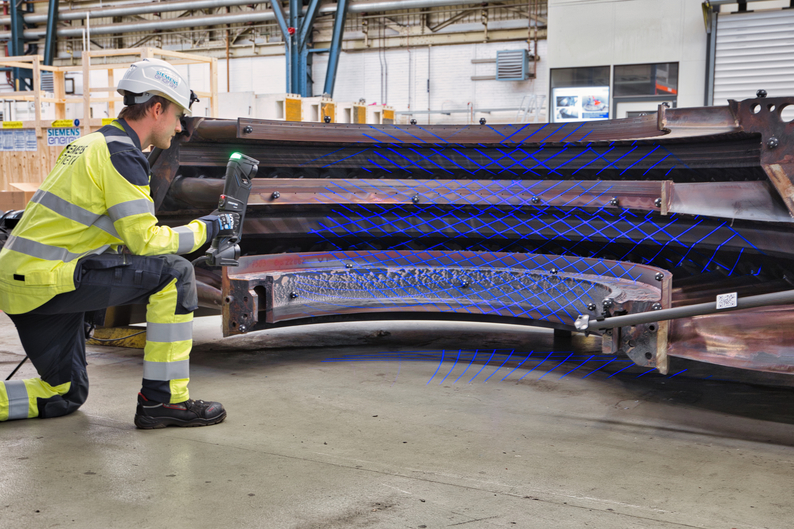
The same approach also enables aftermarket innovations and custom equipment design. When large attachments or modifications must integrate precisely with existing rolling stock, working from accurate 3D data helps engineers design solutions that fit correctly the first time, even in the absence of original CADs.
Beyond vehicles themselves, 3D scanning is increasingly used to document and assess rail infrastructure and facilities. For instance, when gauge-changing facilities are measured in challenging environmental conditions to generate accurate 3D data that supports inspection, comparison over time, and future modernization projects.
Finally, although many applications focus on operational performance, 3D scanning also plays a role in preserving rail engineering heritage. High-resolution 3D data makes it possible to archive historically significant rolling stock like the Romance Car (ロマンスカー, Romansukā) in a form that safeguards decades of institutional memory and ingenuity.
Going Further: A Deeper Look at Where 3D Scanning Delivers More Value in Rail
Taken together, these use cases illustrate how 3D scanning supports rolling stock at multiple stages—inspection, manufacturing, maintenance, modernization, and even preservation.
For organizations looking to understand where 3D scanning technology delivers the most value across rail applications, our guide Extend Rolling Stock Lifespan with 3D Scanning provides a structured perspective on how 3D measurement supports incoming part inspection, quality control, reverse engineering, and maintenance strategies over the long term.
Published 02/02/2026