

- Article
- Related
In the aerospace industry, every composite part must be inspected with absolute precision to ensure safety and compliance. Although essential, this requirement creates many challenges: lengthy inspection times, operator dependence, and production-line integration constraints. To address these challenges, IRT Jules Verne, a French technology research institute specializing in manufacturing, has been conducting advanced automation projects for several years, including the FANTOM project, which focuses on flexible, robotic non-destructive testing (NDT).
Building on previous discussions and projects carried out with IRT Jules Verne, this new initiative deepens our shared exploration of how advanced technologies can be integrated into industrial processes.
Through FANTOM, the institute and its industrial partners aim to demonstrate how robotics, 3D geometry, ultrasound, vision, and AI can be combined within a robotic platform dedicated to NDT. The goal is to explore and validate different approaches to inspection automation, using a FARO CREAFORM MetraSCAN 3D-R to generate the geometric reference that guides every inspection.
A Collaborative Project to Transform Automated NDT
IRT Jules Verne operates within a rich ecosystem that brings together strategic industries, university laboratories, competitiveness clusters, and equipment suppliers. As in many of its projects, the institute has united several stakeholders: Airbus, Daher, Axiome, Testia, and CEA-List. This collaborative effort seeks to create a robotic inspection platform capable of inspecting composite parts reliably, quickly, and adaptably.
The partners contributed to different aspects of the project:
- development of rigid ultrasonic end effectors and flexible membranes (IRT Jules Verne),
- advanced simulation to optimize the probes (CEA-List),
- software integration for NDT data acquisition (Testia),
- definition of critical aerospace use cases (Airbus, Daher),
- implementation of collaborative robotics and robotic paths (IRT Jules Verne, Axiome).
The entire system, however, relies on one essential foundation: precise, reliable geometry that allows the robot to work as close as possible to composite surfaces, at the correct angle and with consistent repeatability. This fundamental building block is where FARO CREAFORM comes in.
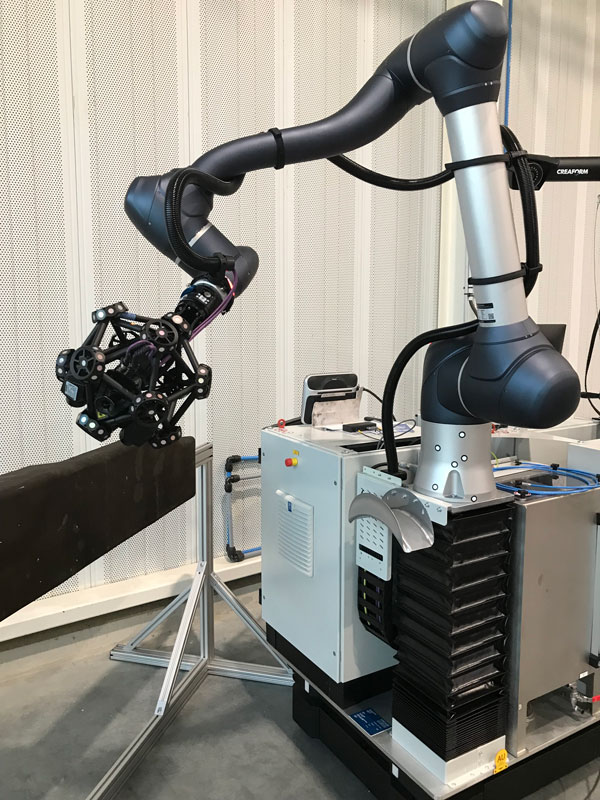
The Central Role of the MetraSCAN 3D-R in Generating Inspection Paths
Although the FANTOM platform combines several technologies, the first, and probably most foundational, step is geometry capture. Aerospace composite parts often feature complex curves, ribs, and reinforced areas. Optimal ultrasonic paths cannot be defined without knowing their actual shape.
Mounted on a collaborative robot, the MetraSCAN 3D-R performs this precise 3D mapping. IRT Jules Verne highlights three decisive advantages:
- Stability and repeatability despite vibrations in a robotic cell.
- Low on-robot weight, which is essential for collaborative robotics.
- Industrial-grade accuracy, which is indispensable for ultrasonic paths.
FARO CREAFORM software modules complement this stage:
- Automation generates, simulates, and adjusts robotic paths.
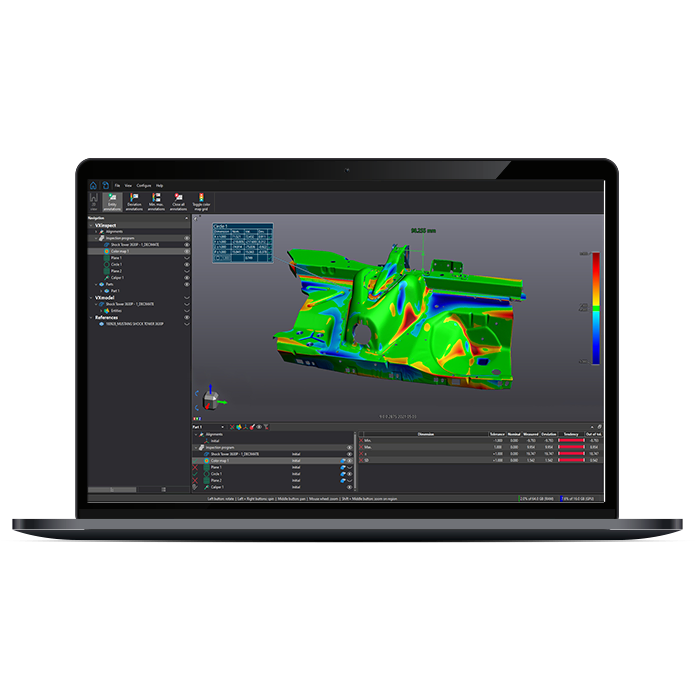
- Inspection uses the geometry to verify deviations and prepare the inspection.
- Dynamic Tracking maintains part-to-robot alignment even when variations or micromovements occur.
The geometry produced by the MetraSCAN 3D-R then becomes the backbone of the inspection process, supporting the ultrasonic, visual, and AI technologies developed by the partners.
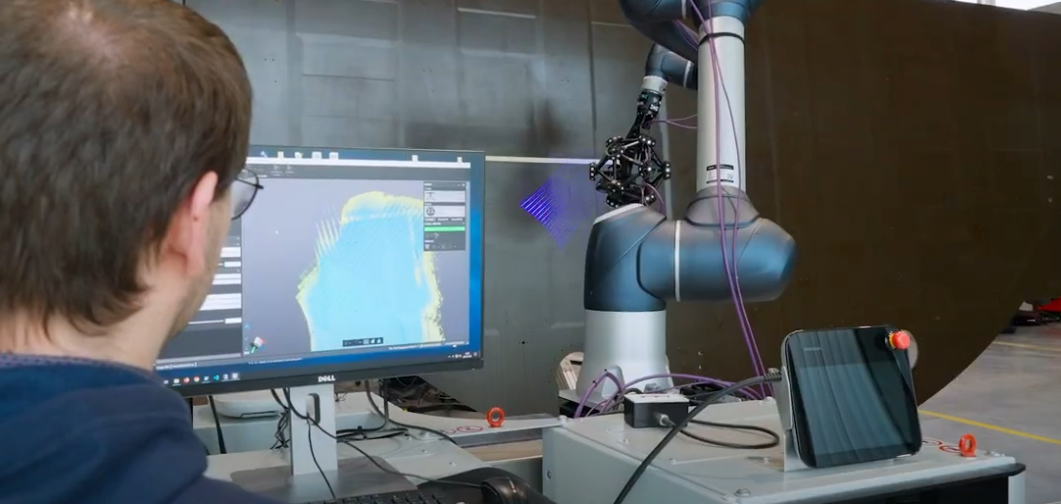
Enhanced, Agile, and Consistent NDT Built Around 3D Geometry
The rigid ultrasonic end effectors, optimized flexible membranes, and AI-assisted vision systems were designed to rely directly on the geometry generated by the scanner. With this foundation:
- the ultrasonic probe automatically remains normal to the surface, maximizing signal quality;
- the visual end effectors are positioned with greater accuracy, improving the detection of scratches, dents, or chipping;
- NDT data can be merged into consistent maps using Testia's tools.
A Platform Designed for Production and Decision-Making
The FANTOM project is not intended solely to automate inspections. It also seeks to study the conditions required to integrate them into an industrial digital chain. In this respect, the geometric structure provided by the FARO CREAFORM system is an important component of the platform. Paths, geometric data, and inspection results can be brought together within a single environment, illustrating the potential for digital continuity between the different stages of the inspection process and, ultimately, with industrial quality management systems.
The visual presentation of indications, directly correlated with the scanned geometry, gives operators a more intuitive representation of inspection results and illustrates the value of this approach in facilitating inspection analysis. This continuity between geometric and inspection data offers a promising avenue for improving information consistency and the flow of quality processes over time.
Why IRT Jules Verne Chose FARO CREAFORM Solutions
Based on the information provided by IRT Jules Verne, several factors clearly explain its choice of FARO CREAFORM technologies to structure the FANTOM project. Above all, the institute needed a solution capable of delivering stable, repeatable accuracy in an industrial environment subject to vibration, while maintaining a low on-robot weight compatible with collaborative robotics. The localization methodology used by FARO CREAFORM systems, combined with their ease of deployment and robustness in a robotic cell, was a major advantage in meeting the project's requirements.
The ability to provide a reliable, usable geometric foundation for both path preparation and dynamic alignment made the MetraSCAN 3D-R a key structural element of the platform. IRT Jules Verne found a technology that could integrate naturally into a complex workflow while providing a solid foundation for all automated inspections.
Preparing the Production Lines of the Future
The FANTOM project demonstrates the feasibility of a flexible NDT platform that combines different inspection technologies and explores their integration within a single robotic environment. The results represent a step toward more advanced inspection automation and future integration into production environments. The approach developed by IRT Jules Verne combines robotics, ultrasound, vision, and artificial intelligence, but rests on one central element: reliable, structured, usable geometry provided by the FARO CREAFORM MetraSCAN 3D-R.
This collaboration illustrates the potential of hybrid solutions combining industrial innovation, advanced robotics, and 3D capture. With a robust geometric foundation, the project partners were able to automate certain stages of the inspection process and explore approaches that could eventually reduce the cost and complexity of historically demanding tasks. This work represents a step toward more automated inspection solutions and, in the longer term, more agile and efficient composite production environments.
Published 11/05/2026