

- Article
- Related
High-mix manufacturing has become the norm. Across industries, production lines are expected to produce more part variants, in smaller batches, and at a faster pace than ever before—all while maintaining very high quality.
To keep up with this pace, many manufacturers turn to automated quality control (AQC). Robots and 3D scanning systems promise consistency, repeatability, and higher throughput. In theory, automation should remove friction from inspection workflows. In practice, however, it often introduces a new and underestimated bottleneck: programming complexity.
When Programming Becomes the Bottleneck
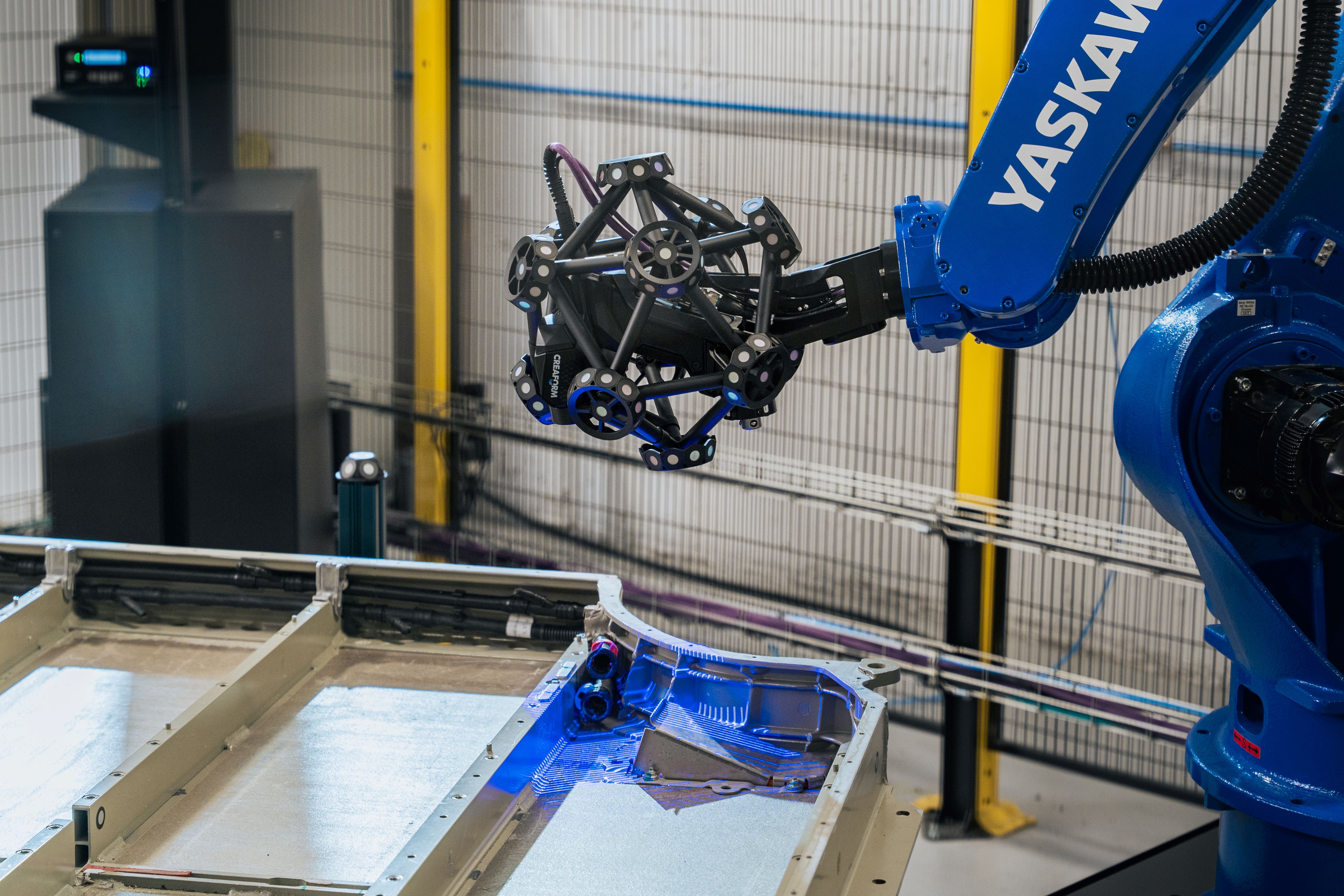
In high-mix, low-volume environments, each new part geometry typically requires a new scan trajectory to be programmed, validated, and optimized. Even minor design changes can trigger hours of reprogramming. What should be a fast transition between parts becomes a time-consuming engineering task that undermines productivity. In such conditions, AQC often becomes impractical for small batches (e.g., 3-10 parts), as programming time outweighs the duration of the inspection task itself.
As part variety continues to increase, reducing the need to repeatedly program new scan trajectories for every single part has become a critical challenge for manufacturers. This article explores how a different approach to scan trajectory programming can address this challenge, enabling scalable and efficient AQC in high-mix manufacturing.
The Problem with Traditional Programming
Conventional robotic inspection relies on part-specific, highly customized scan trajectories that closely follow each surface geometry and require dedicated programming for every new part. Although this traditional technique can be suitable for low-mix, high-volume environments, they create significant inefficiencies in high-mix manufacturing, leading to repeated offline programming, simulation, validation, and on-cell testing that consume high-value engineering time.
As they typically require hours of optimization to achieve reliable results, such automated traditional programming solutions lack practicality for rapid inspection of small batches in First Article Inspection (FAI) or product development contexts.
As a result, instead of accelerating quality control, automation acts as a brake, transforming what should enable productivity into an ongoing operational constraint that consumes time and resources.
From Part-Specific Programming to Simplified Scan Trajectories
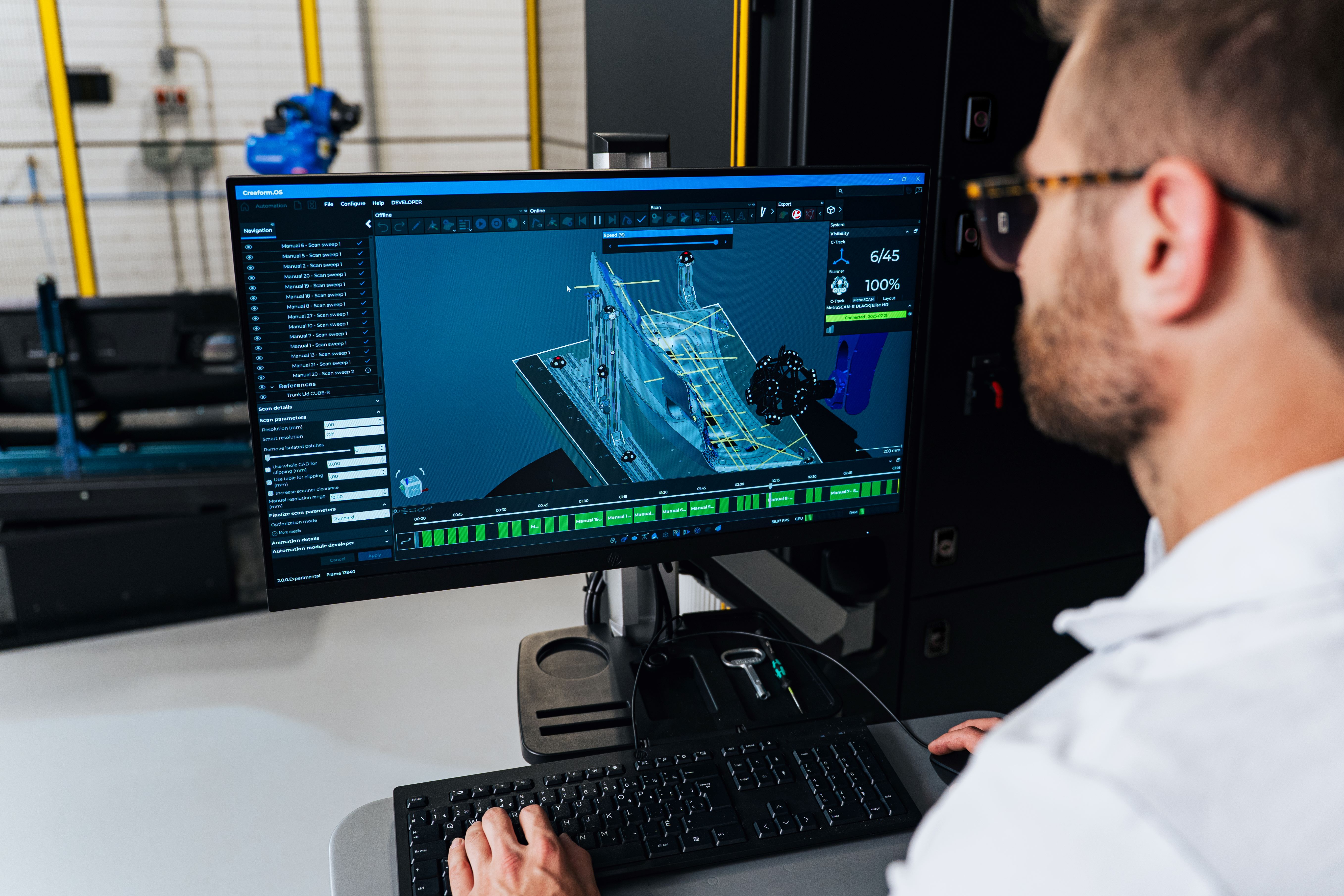
A different approach is needed—one that reduces dependency on part-specific programming. This is where simplified scan trajectories, based on fundamental geometric volumes, change how AQC can be deployed.
Simplified scan trajectories replace part-specific paths with standardized geometric volumes—typically rectangular, cuboid, or cylindrical envelopes—within which the 3D scanner moves relative to the part. Rather than following every surface feature, the trajectory is defined around the part’s overall bounding geometry, ensuring consistent line-of-sight, coverage, and standoff distance across all accessible surfaces.
Because most single parts can be reasonably enclosed within one of these fundamental shapes, predefined trajectories can accommodate wide variations in size, surface detail, and design complexity. This approach preserves measurement completeness and data quality while eliminating the need to redefine scan paths for each new part geometry.
From Programming Burden to Scalable Inspection
By eliminating the need to program new scan paths for each part, simplified scan trajectories significantly reduce programming time and operator dependency, freeing automation specialists from repetitive, low-value tasks.
Standardized trajectories enable faster deployment and easier scalability, allowing manufacturers to introduce new parts into AQC workflows with minimal setup effort. AQC becomes then viable for high‑mix manufacturing, low‑volume parts, prototype and first‑article inspections, and short‑run or one‑off measurement needs. The cumulative effect is a more agile inspection process that delivers a stronger return on investment, especially in high-mix, low-volume production environments where flexibility directly impacts productivity.
Simple Measurement Systems Enable Simplified Scan Trajectories
Trajectory programming is directly influenced by the simplicity of the measurement system used for data acquisition. An easy-to-use 3D scanning solution uses trajectories that prioritize global coverage, which reduces dependency on perfectly optimized scan paths.
Because scan trajectories do not need to be perfect, they can be significantly simplified, which in turn drastically reduces programming time and enables fast automation for high‑mix, low-volume applications.
Automation Kit: Simple AQC Solution That Adapts to High-Mix Manufacturing
The Automation Kit is specifically designed for scenarios where manufacturers need to scan very small quantities of parts, typically from one to ten parts, while keeping investment to a minimum.
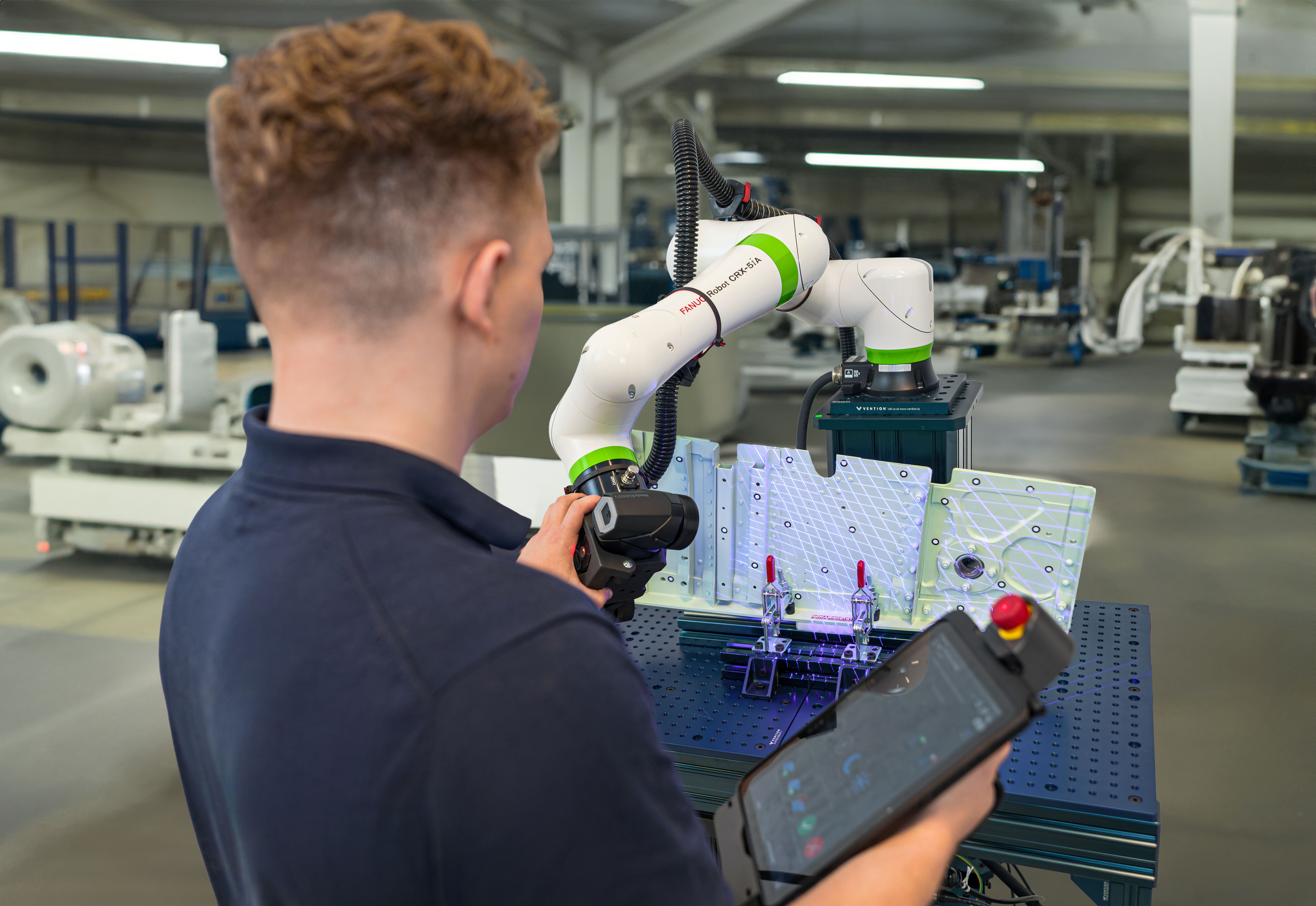
The CUBE-R M Series can also be used with this perspective in mind. Paired with Automation, the digital environment module of the Creaform Metrology Suite, the system supports smart offline programming where simplified scan trajectories can be defined and reused across parts with minimal adjustment.
The result is an AQC solution that minimizes programming effort, facilitates adaptation, and addresses the complexity that was hindering productivity and scalability in high-mix manufacturing.
The Path to Programming Efficiency
As high-mix manufacturing continues to challenge traditional automation models, reducing programming complexity has become essential to achieving efficient, scalable AQC. Simplified scan trajectories—based on standardized geometric volumes—offer a practical way to maintain inspection coverage and data quality while improving programming efficiency.
By pairing this approach with simple AQC solutions like the Automation Kit, manufacturers can move beyond part-specific constraints and unlock more agile, productive inspection workflows.
Explore how the Automation Kit enables scalable and efficient AQC.
Published 06/17/2026