

- Article
- Related
Of the varied industrial manufacturing subsets, metal casting is among the oldest – and most important. Valued at over $150 billion globally, metal casting is a process by which molten metal is poured into a mold and allowed to solidify. This produces a metal part in the shape of the mold.
Bluemount Castings knows this industry well as it’s an established Indian manufacturer of gray iron and ductile iron castings, delivering high quality machined components to customers around the world. Operating under the Bluemount Group, and located in Coimbatore, India, the company has a legacy dating back to 1961 and has matured into a trusted supply chain partner for demanding industrial sectors.
Today, the company serves a wide range of industries, including machine tools, industrial valves, transmission systems, tractors, and the automotive segments in India, North America, Europe, the Asia Pacific region, and the Middle East.
Metrology and 3D Measurement Requirements
Bluemount Group’s manufacturing ecosystem is fully integrated and ISO 9001:2015, Pressure Equipment Directive certified.
.jpeg?h=3120&la=en&w=4160&revision=7d9b33f4-1ed4-45c5-92ec-6f38d586a961&hash=AEB2EACC1D53B0C8B21244EADF6015B1) A member of the Bluemount Team scans a Liquid Cooled Gear Box Ductile Iron Casting as part of Electric Vehicle Transmission as its 3D image appears in real-time at the adjacent workstation.
A member of the Bluemount Team scans a Liquid Cooled Gear Box Ductile Iron Casting as part of Electric Vehicle Transmission as its 3D image appears in real-time at the adjacent workstation. Its in house capabilities include electric induction melting, Automatic green sand machine molding, no bake molding, spectroscopy, metallography, industrial metrology, CNC and conventional machining, assembly, painting, and packing. It’s an integrated structure that allows Bluemount to maintain flexibility in production volumes while ensuring consistent quality across a wide variety of casting geometries.
As a supplier of precision-engineered components to global original equipment managers (OEMs) and top-tier customers, Bluemount depends heavily on accurate measurement and inspection.
The nature of gray and ductile iron castings (particularly those used in valve bodies, gearboxes, and other critical assemblies) require close control over dimensional tolerances, wall thickness, radii, contours and overall geometry.
As one might expect, metrology plays a critical role at several points along Bluemount’s manufacturing lifecycle:
- New part development for customer introductions
- Value engineering and value analysis initiatives
- Inspection and validation of production lots
- Evaluation of tooling, sand molds, and increasingly, 3D printed molds
In each of these capacities, the ability to compare manufactured castings against customer supplied 3D CAD models is essential to ensure conformance and to support effective communication with customers.
The Road to 3D Measurement Results
Before implementing advanced 3D measurement solutions, Bluemount relied on conventional inspection tools and processes. While effective for basic dimensional checks, these methods posed two main challenges:
- Inspection time: Traditional measurement techniques were time consuming, reducing inspection throughput and impacting overall productivity. As part complexity increased, so did the effort required to validate dimensions.
- 3D comparison: Customers increasingly issued detailed 3D CAD models and expected cast components to be validated against those digital references. Conducting comprehensive surface comparisons, evaluating cross sections, and verifying wall thickness using conventional methods was difficult and inefficient.
Bluemount was particularly concerned about the potential risks associated with undetected deviations, such as insufficient wall thickness, incorrect radii, or contour mismatches. These issues could lead to customer rejections, performance concerns in the field, or costly rework and delays.
The turning point came when customers themselves began requesting or submitting inspection reports generated using FARO CREAFORM scanning systems and software. This proved digital 3D measurement had advanced beyond “ad-on perk status” and was becoming a standard expectation.
“FARO CREAFORM’s 3D measurement solutions have given us a reliable and practical way to validate complex castings and communicate clearly with our global customers. The accuracy, portability, and ease of use have helped our teams work more efficiently and with greater confidence."
Dr Senthilkumar C.B., Managing Director, Bluemount Castings Private Limited.
.jpeg?h=3120&la=en&w=3120&revision=fbbee6eb-1c40-4481-a4a7-c409408223b6&hash=71DB1745A3F613E9E7E078FF4C5AE62F) Bluemount Specialist, Rangesh Sriram, uses the HandySCAN 3D and scans an Aluminum Pattern for Liquid Cooled Gear Box used for Electric Vehicle Transmission.
Bluemount Specialist, Rangesh Sriram, uses the HandySCAN 3D and scans an Aluminum Pattern for Liquid Cooled Gear Box used for Electric Vehicle Transmission. FARO CREAFORM’s 3D Measurement Solution
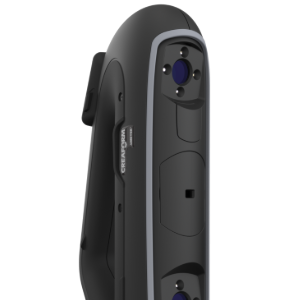
After evaluating available options, Bluemount selected FARO CREAFORM’s HandySCAN 3D measurement solutions based on several advantages.
Unlike fixed CMMs, FARO CREAFORM’s handheld scanning solutions allowed Bluemount to capture data directly on the shop floor, near the production line, or in tooling and mold areas, greatly reducing handling time and logistical constraints.
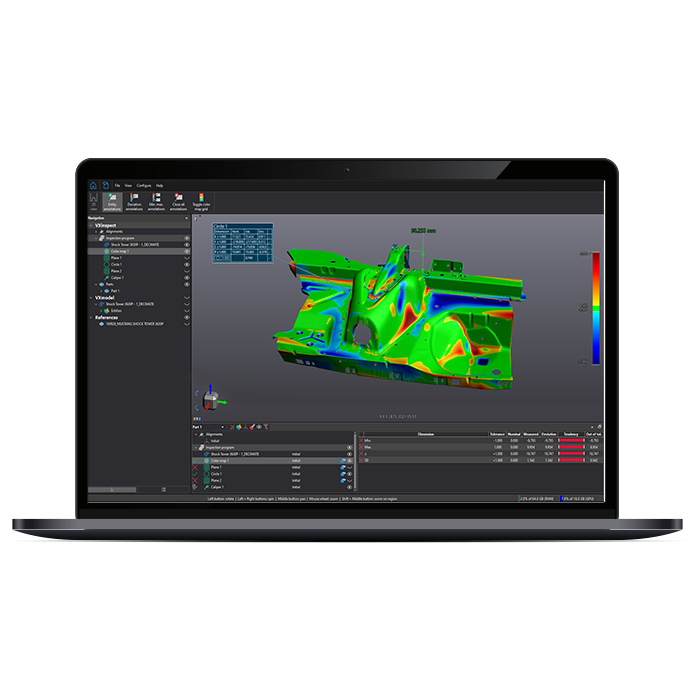
The speed of measurement and reporting was also critical. Customers expect fast turnaround of 3D comparison reports, often with minimal opportunity for iterative inspection cycles. FARO CREAFORM’s hardware and software made it possible to generate detailed, repeatable reports with minimal operator intervention.
Finally, Bluemount valued the ease of use of both the scanning hardware and software platform, as well as the availability of training and technical support.
Implementation and User Adoption
The implementation of FARO CREAFORM’s 3D measurement solution was smooth and efficient. Both hardware installation and software setup were completed without disruption to ongoing operations.
Onboarding the team was quick, and users were able to begin scanning and analyzing real parts early in the adoption process.
While familiarity developed rapidly, Bluemount estimates that it took approximately six months for users to become fully confident across a wide range of applications, including advanced analysis and reporting.
This gradual learning curve allowed the team to integrate 3D scanning naturally into existing quality and engineering workflows, rather than treating it as a standalone activity.Project Use Case: Casting Qualification and Customer Approval
One representative project highlighting the value of FARO CREAFORM’s system involves the qualification of valve-related castings supplied to global customers. Using the 3D solution, engineers scan the finished casting and compare it to the customer’s 3D CAD model.
This process enables comprehensive validation of all critical dimensions, wall thickness, contours, and surfaces. Once dimensional compliance is confirmed, Bluemount proceeds with downstream activities such as 3D printed molds for shell casting, gearbox castings, and tooling for electric vehicle components.
The ability to perform this validation accurately and efficiently has become a key enabler for faster product approvals and smoother customer collaboration.
Measurable Benefits and Workflow Improvements
Since adopting these technologies, Bluemount Castings has experienced several improvements, including clear visuals with technically robust 3D comparison reports, enhanced operational efficiency, and an anticipated ROI boost.
Bluemount also praised FARO CREAFORM’s ability to design 3D scanning applications that are easy to use when constructing solids, performing measurements, and analyzing deviations.
Compared with other tools, the software offers superior capabilities for reverse engineering, which is increasingly important when dealing with legacy parts, tooling replication, or design optimization projects.
The tight integration between scanning hardware and software simplifies workflows, reduces dependency on multiple tools, and enhances overall productivity.
Future Plans for 3D Measurement Technologies
Looking ahead, the company plans to expand its use of 3D measurement technologies across additional applications.
These include:
- Measurement and inspection of machined parts
- Electroplated component validation
- Complete reverse engineering of parts for redesign and optimization
Together, these initiatives reflect Bluemount’s broader strategy of investing in advanced digital tools to support quality, innovation, and long term customer partnerships.
“We see this technology as an important part of our quality and engineering roadmap going forward,”
Dr Senthilkumar
Published 05/15/2026