

- Article
- Related
Everllence, a technology leader in propulsion, energy efficiency, and decarbonization across the maritime, energy, and industrial sectors, was challenged with inspecting several identical six-stage radial gear compressors for a Carbon Capture, Utilization, and Storage (CCUS) plant. Each machine, measuring approximately 3 m × 3 m × 3 m, required accurate 3D measurements of all inlet and outlet flanges, as well as the positions and interfaces of the existing pipes. The goal was to determine how much the connection surfaces deviated from the CAD model and to identify possible differences between the individual machines.
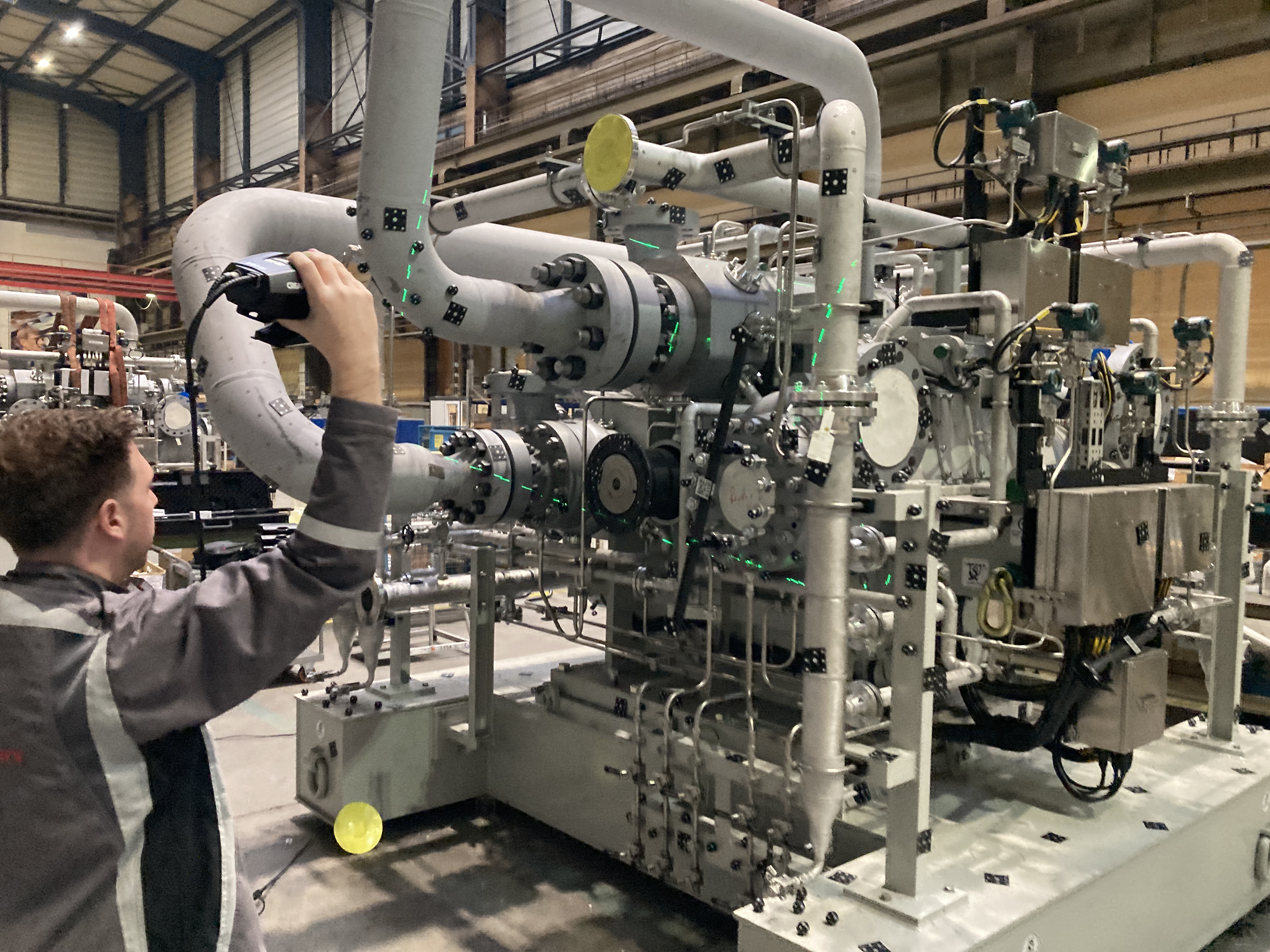 Everllence operator performing large-scale dimensional inspection of an industrial machine using the FARO CREAFORM MaxSHOT 3D, with photogrammetry targets distributed across the structure for high-accuracy measurement.
 Challenges: Considering the complexity, geometry, and size of the machines, why were conventional measuring tools too difficult - or even impossible - to use?
Because of the intricate geometry and large dimensions, traditional measuring tools were simply not suitable. Simple instruments, such as calipers, could not capture the complex shapes involved. The machines were also too large to fit on a coordinate measuring machine (CMM). Since all five sides—front, back, left, right, and top—had to be recorded relative to one another, a laser tracker was also unsuitable, as not all surfaces were visible from a single position. Other optical systems were ruled out as well, as the machine’s height exceeded the limits of a standard tripod setup.
Only optical measurement technology could provide complete and accurate results.
What made optical measurement technology the obvious choice?
Other measuring methods not only lacked accuracy but also relied heavily on operator skills, for example, when performing play control with feeler gauges. The results they produced were often ambiguous and difficult to interpret, amounting to a “graveyard of numbers”. In contrast, optical measurement delivers clear, visual, and highly accurate data that anyone on the team can understand and use with confidence.
What other mobility constraints influenced the choice of measuring technology?
For this project, the measurements had to be carried out directly in the production environment, specifically in the packaging and pipe assembly area. The chosen solution also needed to be flexible enough to operate at different measuring stations across the shop floor, as well as at other sites and customer facilities—both indoors and outdoors.
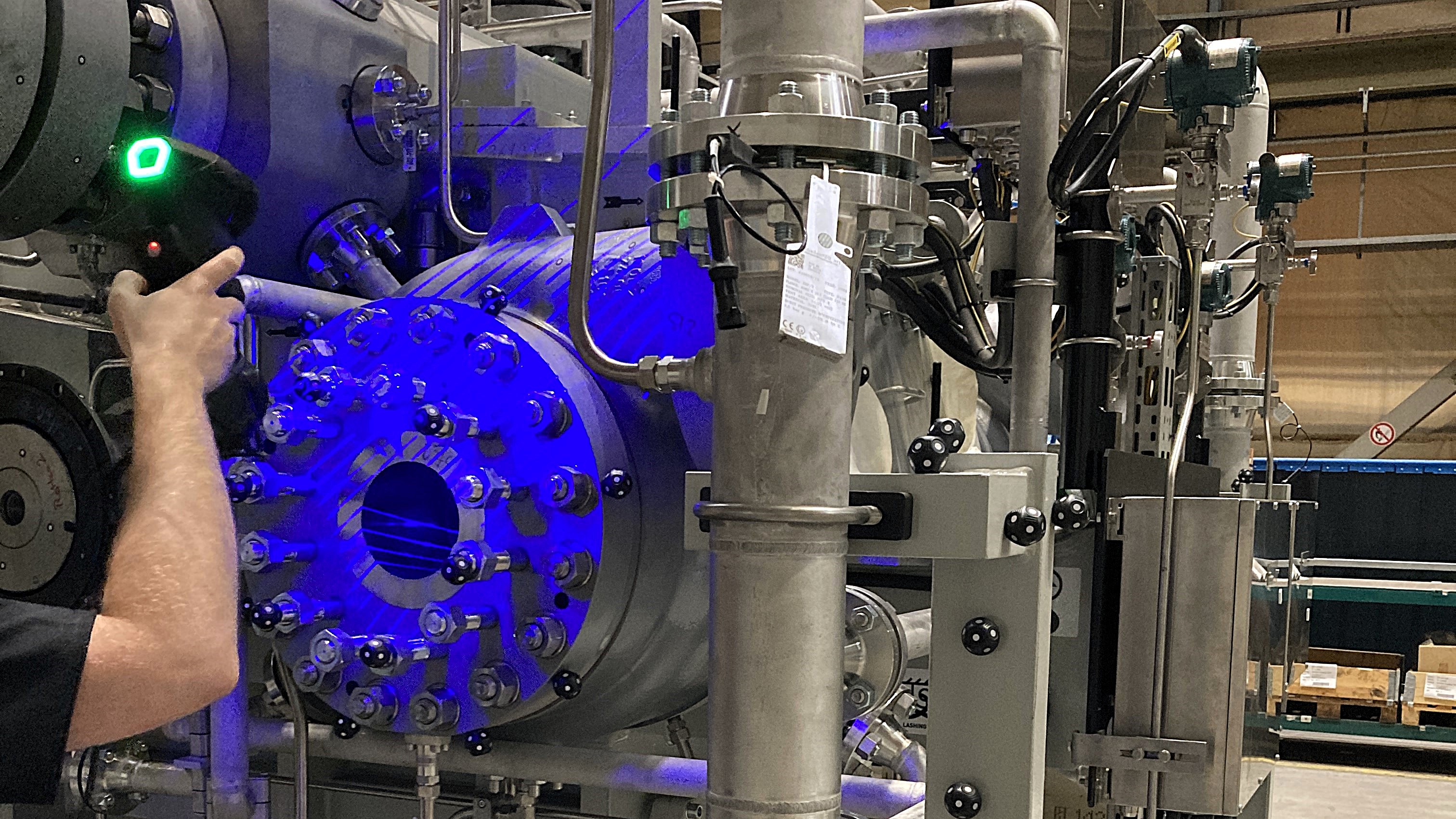 Everllence technician using the FARO CREAFORM HandySCAN 3D to capture accurate measurements on a complex flange assembly during on-site inspection.
 Solution: Accurate, Portable, Simple, and Proven 3D Scanning Devices
Accuracy
Because of the machine’s large dimensions—approximately 3 m × 3 m × 3 m—a combination of photogrammetry and 3D scanning was required to achieve high accuracy across the entire assembly. The solution also provided the flexibility to scan large components quickly and efficiently from a longer distance using the Far Mode, which limited the number of targets, while the Near Mode allowed for the capture of smaller areas with fine detail and resolution. For medium-sized components, the Scale Bar Mode offered an effective alternative to photogrammetry, maintaining accuracy while further simplifying the workflow.
Portability
Thanks to its ergonomic, handheld, and portable design, the solution could be used flexibly both in the factory and on site at customer facilities. Measurements were not limited to the designated measuring station but could also be performed directly in various assembly areas. This mobility was particularly valuable when certain surfaces were difficult to access due to complex piping layouts or spatial constraints.
Simplicity
The solution was remarkably easy to learn and even enjoyable to use, as results were obtained quickly and effortlessly. Compared to other photogrammetry systems, it offered simplified operation features—such as a projected frame with color feedback—that made setup and alignment straightforward. Operators typically needed only one to five measurements to feel confident using the system, representing a very short familiarization period compared to alternative solutions.
The software was equally intuitive, allowing users to begin scanning after just a few clicks. Clear color codes instantly indicated how well targets and scale bars had been captured, while real-time, high-resolution visualization of scan progress further enhanced ease of use throughout the acquisition process.
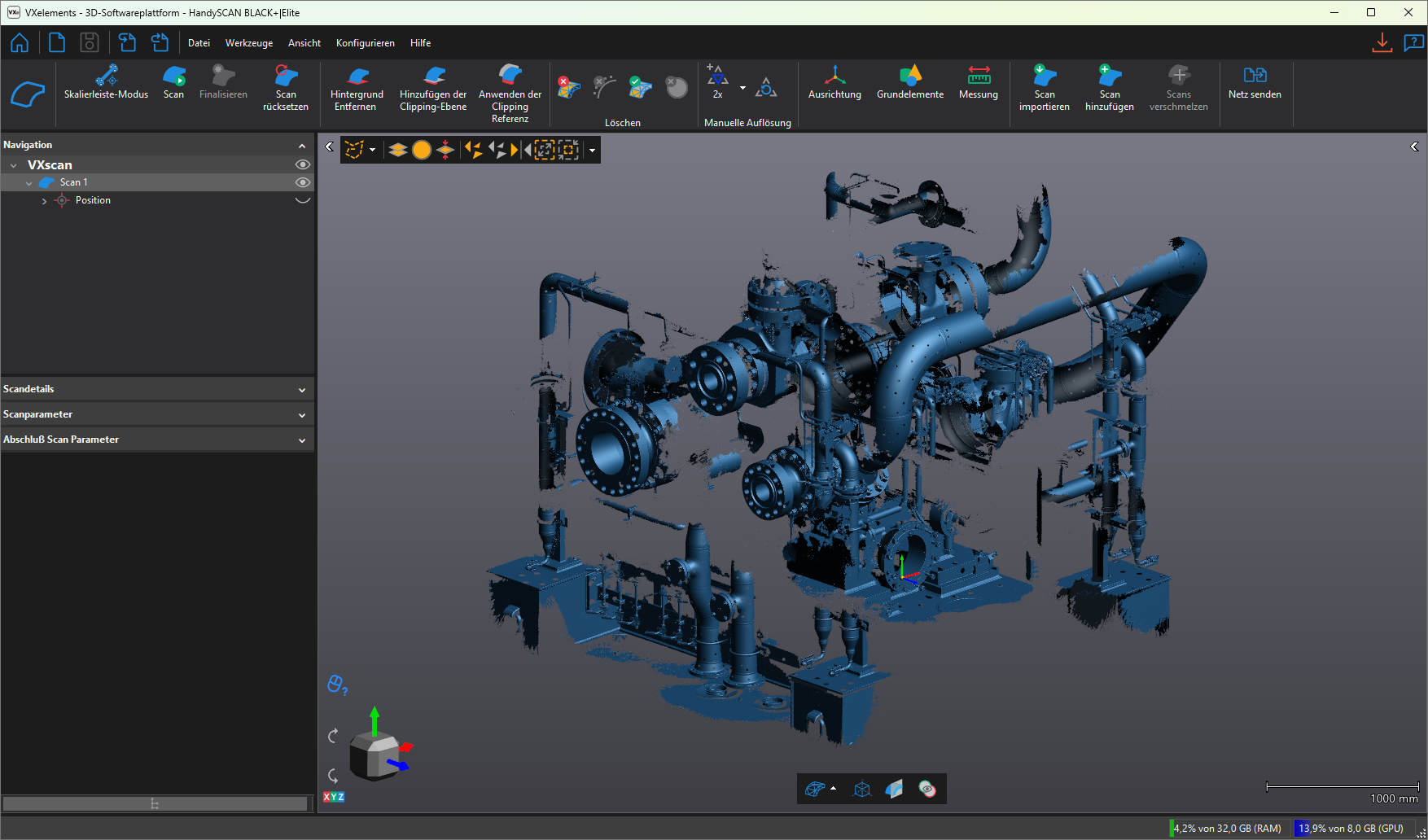 3D scan of a large industrial machine assembly captured by Everllence using the FARO CREAFORM MaxSHOT 3D and visualized as a full digital mesh model in the Creaform Metrology Suite.
 Proven Technology
Beyond specifications, the customer sought a reliable and established manufacturer—one with a proven track record in optical measurement technology. Choosing a trusted partner ensured access to readily available customer support and comprehensive training programs for fast and easy onboarding. In addition, the evolving software guaranteed regular updates and continuous new features.
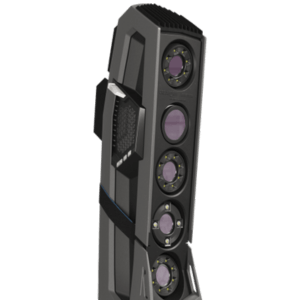
The HandySCAN 3D for large parts, the MaxSHOT 3D, and the Creaform Metrology Suite are good examples of such accurate, portable, easy-to-use, and proven photogrammetry and 3D scanning solutions.
Benefits: Greater Efficiency, Speed, and Customer Value
From improved operational efficiency to faster project turnaround and enhanced customer satisfaction, these benefits allow companies to provide better service and lasting competitive value.
Time Savings
Significant time is saved throughout the entire project with a versatile measuring solution that adapts to any situation. Whether dealing with large components, intricate geometries, or challenging environments, measurements can be performed directly on the shop floor or even at customer sites. Easy to learn and operate, the system allows any team member to measure anything, anywhere.
Better Efficiency
By bringing high-accuracy measurement directly to the production floor, inspection teams can now perform metrology tasks flexibly at any location—eliminating bottlenecks and internal transport delays. This way, multiple large projects to be carried out simultaneously, improving throughout and efficiency across all departments.
Customer Satisfaction
For customer-oriented companies, adopting the latest technology is key to meeting high-quality standards and delivering faster results. Shorter lead times and quicker responses to inquiries strengthen trust and satisfaction. In the end, when high quality is combined with time savings, customers are satisfied—driving repeat business and new opportunities.
Client: Everllence
Everllence (formerly MAN Energy Solutions) is a global leader in propulsion, decarbonization, and efficiency technologies serving the shipping, energy, and industrial sectors. Headquartered in Germany with a workforce of about 15,000 employees across 140 locations worldwide, the company drives measurable progress in the global energy transition by helping major industries reduce hard-to-avoid emissions.
Within Everllence’s Repair Engineering department, engineers carry out detailed inspections and special analyses to assess component damage, document delivery conditions, and support R&D and quality control for metallic 3D-printed (LPBF) parts. For complex geometry capture—especially on components requiring full five-side measurement—traditional tools such as calipers, CMMs, or laser trackers proved unsuitable.
FARO CREAFORM’s photogrammetry and 3D scanning solutions provided the ideal solution. The HandySCAN 3D and MaxSHOT enabled accurate and complete 3D measurements, as well as efficient data acquisition where other systems fell short. As Thorben Blohm, Design Engineer at Everllence in Oberhausen, explains, “The combination of user-friendliness and accuracy is unbeatable for us.”
Published 04/21/2026